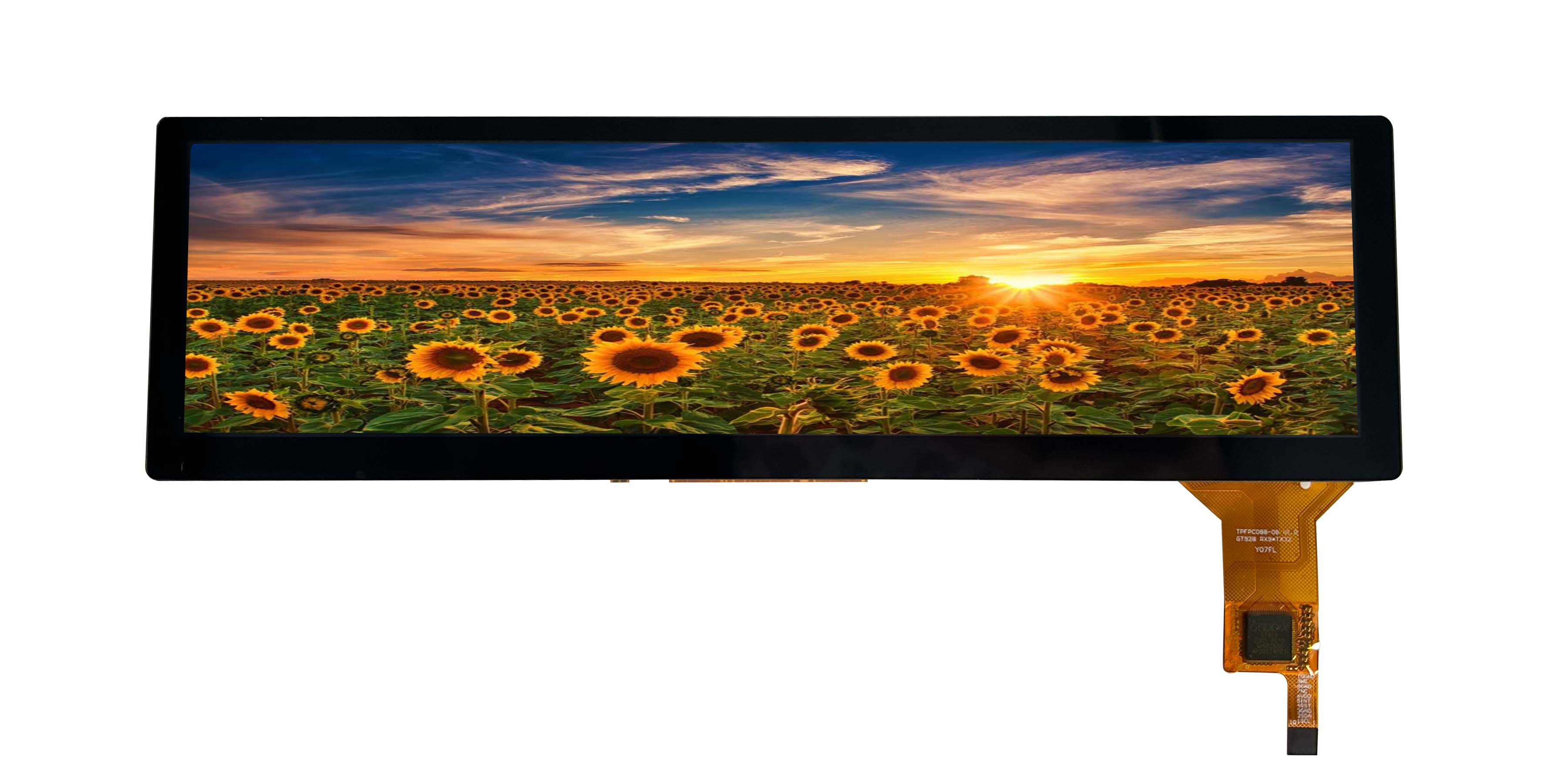
Slow-mo visuals create subtle bar LCD animation by using frame rates under 15 FPS, low-contrast gradients, and smooth transitions to attract eyes without annoyance. This prevents flicker on stretched LCDs, reduces eye strain in retail or automotive settings, and leverages OCA optical bonding for seamless motion—ideal for CDTech's high-brightness bar displays like the 12.3" S123BWU09NP-FC19-AF with zero-defect quality standards.
Check: How Do You Design Effective UI for Bar Display Aspect Ratios Like 16:3 and 32:9?
What Are Bar LCDs and Why Do They Need Special Motion Graphics?
Bar LCDs are elongated TFT displays with ultra-wide aspect ratios, ranging from 2.9" to 12.3" diagonally, designed for HMI panels, retail signage, and automotive dashboards. CDTech manufactures advanced bar LCD solutions such as the 8.8" S088AWX22EB-DC08 with 1280×320 resolution and 1000 nits brightness, and the 12.3" S123BWU09NP-FC19-AF featuring PCAP multi-touch and OCA optical bonding. These stretched formats require specialized motion graphics because their elongated aspect ratios amplify visual artifacts like flicker and tearing during fast animations, potentially distracting users in high-stakes environments such as vehicle dashboards or industrial control interfaces. With 13+ years of TFT LCD manufacturing experience since 2011, CDTech operates a 10,000㎡ factory with a 3,500㎡ dust-free workshop, ensuring bar LCD panels maintain consistent quality for demanding motion-heavy applications across automotive, retail, and instrumentation sectors.
Why Do Distracting Animations Fail on Bar LCD Displays?
Fast animations above 30 FPS cause noticeable flicker on LVDS interfaces, the standard connection for CDTech's 7"+ bar displays, overwhelming viewers with sensory stimulation. Aggressive color contrasts and rapid transitions accelerate eye fatigue in bright, sunlight-readable environments—critical in automotive bar LCDs operating at up to 1000 nits. Overly flashy motion reduces readability of content like price updates or status gauges, paradoxically eroding customer engagement in retail settings. CDTech's IATF16949 and ISO9001 certifications ensure zero-defect panels capable of supporting smooth, controlled animations across extended temperature ranges (-20°C to +70°C), making properly designed slow-mo visuals essential for maintaining user focus and application reliability.
How Does "Slow-Mo" Visuals Attract Eyes Without Annoying Viewers?
Slow-motion visuals at 8–12 FPS with easing curves—such as bezier transitions in professional design software—mimic natural, organic motion that subtly draws attention without cognitive overload. This technique maintains viewer focus on content while reducing sensory fatigue, making it ideal for motion graphics on LCD displays in retail environments, automotive dashboards, and industrial HMI panels. Research adapted to bar LCD formats indicates that slow-mo animations can boost content dwell time by 20–30%, as users intuitively recognize motion as a non-threatening attention signal rather than disruptive flashing. CDTech's bar type LCDs, including PCAP multi-touch variants, support this seamless animation capability through high-refresh hardware and in-house OCA optical bonding, ensuring motion appears smooth and natural without air-gap artifacts or parallax distortion.
| Animation Type | FPS Range | Distraction Level | Best Use Case | CDTech Model Fit |
|---|
| Fast/Flashy | 30+ | High (flicker) | Not Recommended | Avoid |
| Standard | 15–24 | Medium | Menu Transitions | S088AWX22EB-DC08 |
| Slow-Mo | <15 | Low | Signage & HMI | S123BWU09NP-FC19-AF |
What Are the Best Practices for Subtle Bar Display Animation?
Stretched LCD animation best practices include using vector-based gradients instead of raster elements, limiting active on-screen motion elements to 3–5 per frame, and testing prototypes on high-brightness displays to verify motion smoothness under real-world lighting conditions. Pairing slow-mo visuals with PCAP capacitive touch ensures that user gestures and animations do not conflict, maintaining responsive HMI experiences. CDTech's in-house customization capabilities support low-MOQ production runs for animation-optimized panels with anti-glare (AG) and anti-fingerprint (AF) surface treatments, enabling clients to prototype and deploy motion-enhanced bar LCDs quickly. Key specifications like the 1280×320 resolution on CDTech's 8.8" bar model and 1000 nits brightness on the 12.3" variant provide sufficient pixel density and luminance to render smooth gradients and subtle motion without visual banding or temporal artifacts.
How Does OCA Optical Bonding Enhance Motion Graphics on Bar LCDs?
OCA (optically clear adhesive) bonding eliminates the air gap between a touch panel and LCD layer, reducing light scattering and parallax effects that would otherwise distort or blur moving visuals. This technology is particularly critical for bar LCDs used in sunlight-readable automotive and retail applications, where reflections and glare typically degrade animation clarity. CDTech established its in-house touch panel and OCA bonding workshop in 2020, enabling full customization of bar LCD displays with integrated PCAP or CTP touch and optical bonding in a single integrated assembly. The 12.3" S123BWU09NP-FC19-AF, for instance, combines LVDS display technology with OCA bonding and 5-point capacitive touch, delivering seamless motion graphics without the visual artifacts that plague non-bonded displays. This integration is particularly valuable for applications requiring high nits, long operating life, and flawless motion rendering across temperature extremes.
Which Industries Benefit Most from Non-Distracting Bar LCD Animation?
Automotive bar LCDs benefit significantly from subtle motion graphics, particularly in instrument clusters and dash displays where slow-mo gauge animations guide driver attention without distraction. Retail signage leverages non-distracting bar LCD animation to promote products and prices dynamically while maintaining visual harmony—critical in high-traffic environments where aggressive motion causes sensory fatigue. Industrial HMI and control panels use slow-mo bar displays to communicate status changes, alerts, and process flow with minimal cognitive load on operators during precision tasks. Medical instrumentation and smart-home applications also benefit from understated motion design that conveys information without alarming users. CDTech's quad-certified bar LCDs (ISO9001, ISO14001, ISO13485, IATF16949) are exported globally to Europe, the Americas, the Middle East, Russia, Japan, and Taiwan, proving their reliability across mission-critical motion-heavy applications in automotive, industrial, and commercial sectors.
How to Implement and Test Slow-Mo Bar LCD Animations?
Begin by prototyping motion designs with CDTech's standard bar LCD models—such as the 6.5" S065BWS08HD or 12.3" variants—and use LVDS interfaces to ensure low-latency signal transmission, critical for synchronized animation timing. Design animations in professional software like Adobe After Effects using bezier easing curves set to 8–12 FPS, then export frame sequences for integration via HDMI or UART-based interfaces supported by CDTech's HMI panel solutions. A/B test the animations on actual hardware under target lighting conditions (e.g., high-brightness automotive environments or retail store settings) to verify motion smoothness, color accuracy, and lack of flicker. Document frame-by-frame performance metrics and user feedback, then iterate with CDTech's R&D team—which maintains 10+ years of industry experience—to refine animations for your specific application. Low-MOQ custom development ensures production feasibility even for specialized motion-heavy projects.
Check: BAR Type LCD Display
CDTech Expert Views
"Our ISO13485 and ISO9001-certified manufacturing process delivers automotive-grade bar LCD displays with flawless slow-mo motion graphics, thanks to our 2024 fully automatic POL/LCD/CTP bonding equipment and in-house OCA integration. The 12.3" S123BWU09NP-FC19-AF, rated at 1000 nits with IATF16949 compliance, eliminates air-gap artifacts that compromise animation fluidity. Our zero-defect quality policy ensures 99.9% uptime for motion-heavy HMI deployments across Europe and Asia, with response times within 24 hours for custom prototyping."
Conclusion
Slow-mo visuals represent a scientifically sound and commercially viable approach to bar LCD animation that balances user engagement with cognitive comfort. By maintaining frame rates below 15 FPS, employing smooth easing functions, and leveraging OCA optical bonding technology, designers and engineers can create animations that attract attention without distraction—ideal for automotive dashboards, retail signage, and industrial HMI environments. CDTech's 13+ years of TFT LCD manufacturing expertise, combined with quad-certified quality standards (ISO9001, ISO14001, ISO13485, IATF16949), make it a trusted partner for deploying high-brightness, animation-optimized bar displays. Whether you require standard bar LCDs in sizes from 2.9" to 12.3" or fully custom motion-graphics-ready panels with PCAP touch and OCA bonding, CDTech's 10,000㎡ factory and in-house customization capabilities deliver reliable, zero-defect solutions. Contact CDTech today at sales@cdtech-lcd.com to prototype your next motion-enhanced bar LCD application and bring subtle, engaging visuals to your end users worldwide.
Frequently Asked Questions
What FPS range is optimal for bar LCD slow-mo animation?
Frame rates under 15 FPS create perceptibly smooth slow-motion without flicker on bar LCDs. CDTech's high-refresh LVDS panels support this range seamlessly, delivering natural, non-distracting motion in automotive and retail applications. Testing at 8–12 FPS typically yields the best balance between visual smoothness and minimal eye strain across bright environments.
Can CDTech customize bar displays specifically for motion graphics?
Yes. CDTech offers low-MOQ custom bar LCD development with fully integrated PCAP touch, OCA optical bonding, anti-glare treatment, and LVDS or RGB interfaces tailored for motion-heavy HMI and signage applications. The company's in-house touch and bonding workshops enable rapid prototyping and production of animation-optimized displays in sizes up to 12.3".
How does OCA bonding prevent animation distortion on bar LCDs?
OCA optical bonding eliminates air gaps between the touch panel and LCD layer, reducing light scattering, parallax, and reflection artifacts. This creates seamless visual continuity essential for smooth slow-mo animations, especially in high-brightness (1000 nits) automotive and sunlight-readable retail bar displays where reflections would otherwise blur or distort moving visuals.
Are CDTech bar LCDs certified for automotive use?
Absolutely. CDTech's bar LCD displays, including the automotive-grade 12.3" S123BWU09NP-FC19-AF and 12.3" S123BWU11EP models, hold full IATF16949 certification alongside ISO9001 and ISO13485, ensuring compliance with automotive industry quality and reliability standards. These displays support wide operating temperatures (-20°C to +70°C) and zero-defect manufacturing, making them ideal for vehicle dashboards and instrument clusters with animation requirements.
What certifications support CDTech's zero-defect quality promise?
CDTech maintains ISO9001 (quality management), ISO14001 (environmental management), ISO13485 (medical device quality), and IATF16949 (automotive quality) certifications. Additionally, the company holds National High-Tech Enterprise status (2015) and Shenzhen Software Enterprise recognition, demonstrating long-term commitment to manufacturing excellence, rigorous testing, and zero-defect delivery across all bar LCD applications.