News
Site Editor
 Site
https://cdtech-lcd.usa72.wondercdn.com/uploads/image/5faca15e24cff.png
A detail hidden between the LCD panel and the cover glass often decides whether a display remains clear under sunlight, resists humidity, and survives years of vibration. That detail is the space between layers. Some displays keep a thin layer of air there. Others fill it with a transparent optical adhesive through a process known as optical bonding. The difference is invisible from the outside but obvious once the screen is installed in real equipment.
Site
https://cdtech-lcd.usa72.wondercdn.com/uploads/image/5faca15e24cff.png
A detail hidden between the LCD panel and the cover glass often decides whether a display remains clear under sunlight, resists humidity, and survives years of vibration. That detail is the space between layers. Some displays keep a thin layer of air there. Others fill it with a transparent optical adhesive through a process known as optical bonding. The difference is invisible from the outside but obvious once the screen is installed in real equipment.
Optical Bonding vs Air Gap: Which Is Better for LCD Display Screens
Views: 1618
Author: Site Editor
Publish Time: 2026-04-08
Origin: Site
A detail hidden between the LCD panel and the cover glass often decides
whether a display remains clear under sunlight, resists humidity, and survives
years of vibration. That detail is the space between layers. Some displays keep
a thin layer of air there. Others fill it with a transparent optical adhesive
through a process known as optical bonding. The difference is invisible from the
outside but obvious once the screen is installed in real equipment.
Two modules may look identical on a workbench yet perform very differently
on a tractor, a construction machine, a marine console, or an outdoor terminal.
Understanding how air gap and optical bonding affect light transmission,
contrast, reliability, and durability helps determine which structure fits the
working environment of the LCD display screen.
Structural Difference and Its Optical Impact
A traditional air gap design places air between the LCD glass and the
protective cover lens or touch panel. Manufacturing stays simple, costs remain
lower, and repairs are easier because layers can be separated. Optically, air
creates multiple glass–air transitions. Each transition reflects and scatters
part of the light coming from the backlight and part of the ambient light
hitting the surface.
Optical bonding removes that air layer completely. A clear adhesive with a
refractive index close to glass fills the space and bonds the layers into one
optical unit. Light no longer passes through disruptive glass–air–glass
boundaries. Reflection drops sharply, scattering is minimized, and more usable
light reaches the viewer.
This structural change directly influences how the display behaves in
bright environments.
Sunlight Readability, Contrast, and Visual Quality
Air gap displays struggle outdoors because reflected ambient light
accumulates between layers. The screen begins to look gray and washed out.
Increasing backlight brightness offers limited improvement because internal
reflections still reduce effective contrast.
Optically bonded displays transmit more light outward and reflect less
light inward. Blacks remain darker, colors look more saturated, and the image
appears closer to the surface of the glass. Engineers often describe this effect
as the image being “painted” on the cover lens. The improvement becomes
especially noticeable in construction equipment, agricultural vehicles, marine
systems, and outdoor kiosks where direct sunlight is unavoidable.
Resistance to Moisture, Fogging, and Environmental Stress
Humidity and temperature changes expose another weakness of air gap
structures. Moisture trapped inside the cavity condenses when temperatures drop,
creating fogging between layers. Over time, this can lead to corrosion and
permanent damage.
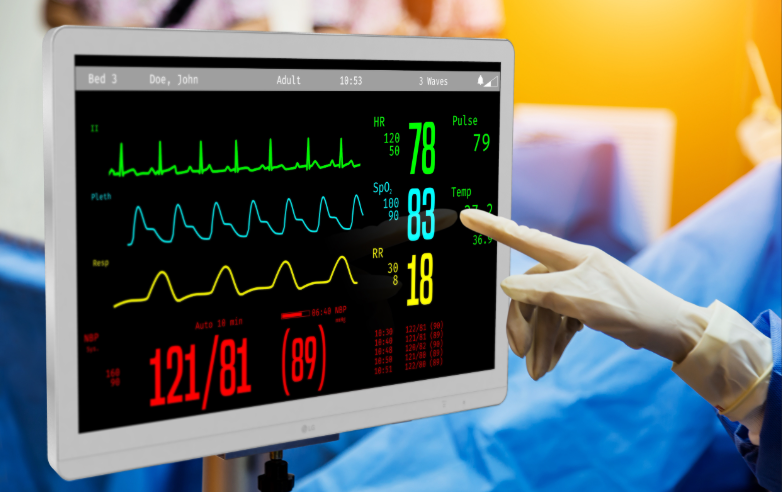
Optical bonding leaves no cavity for moisture to collect. Displays remain
clear in environments such as food processing facilities, cold storage areas,
medical rooms, and marine equipment where humidity and temperature variation are
common.
Mechanical reliability also improves. Air gap layers can move
microscopically during vibration, eventually causing visual defects such as
Newton rings or allowing dust to migrate between layers. Bonded displays behave
as a single solid unit, offering far better resistance to shock and continuous
vibration found in vehicles and heavy machinery.
Touch Accuracy, Thermal Behavior, and Long-Term Stability
Touch performance benefits from optical bonding as well. In air gap
designs, the touch surface sits above the image plane, creating parallax where
the perceived touch point does not perfectly match the displayed content.
Bonding removes this distance and aligns the touch surface optically with the
image, improving precision and usability, particularly in bright light.
Thermal behavior differs too. Air acts as an insulator, limiting heat
dissipation from the backlight and LCD. Optical adhesive conducts heat better
than air, spreading it across the glass surface and improving stability in
high-temperature conditions. This reduces the risk of display darkening or
blackening during prolonged exposure to heat.

Cost, Maintenance, and Practical Selection
Air gap construction remains popular because it is economical and easier to
service. If the cover glass breaks, replacement is often possible without
discarding the entire module. For indoor equipment, office devices, POS
terminals, and control panels in stable environments, this approach is often
sufficient.
Optical bonding increases manufacturing cost and makes rework difficult.
Bonded units are typically replaced as a whole if damaged. The added cost,
however, brings substantial gains in readability, durability, and environmental
resistance.
Choosing Based on the Working Environment
Air gap works well where lighting is controlled, humidity is low, and
mechanical stress is minimal. Optical bonding becomes essential where displays
face direct sunlight, vibration, moisture, temperature fluctuation, or outdoor
exposure.
The better option depends less on theory and more on where the LCD display
screen will operate. Indoor devices may function perfectly for years with an air
gap structure. Industrial and outdoor equipment often depends on optical bonding
to remain readable and reliable throughout its service life.
Optical Bonding, Cover Glass and Protective Layers