Fast IPS vs Standard IPS: What the Response Specification Really Changes
Views: 466Author: Site EditorPublish Time: 2026-09-30Origin: Site
Two panels can carry the same ""1 ms"" line in a quotation and behave completely differently on a machine. The gap is not marketing dishonesty so much as measurement definition: response is a transition time measured under stated conditions, and those conditions decide whether the number describes your product or a laboratory bench. Buying on the figure alone is how a fast IPS panel ends up in a design that never needed it, or a standard panel ends up in one that did.
Is fast IPS actually different from standard IPS?
Same cell family, different drive and cell tuning.
Fast IPS is an in-plane switching panel tuned for shorter transitions, usually through drive voltage, overdrive and cell-gap choices rather than through a different liquid crystal family, so the viewing-angle and colour behaviour stays close to the standard version.
That matters commercially, because it means the fast variant is a performance point on a continuum rather than a separate technology. The pixels still switch in the plane of the substrate, so colour stability off axis is preserved. What changes is how hard the panel is driven and how the response is traded against contrast, power and sometimes uniformity. A specification that names ""fast IPS"" without stating the transition definition has named a family, not a requirement, and the supplier is free to interpret it.
Where does the response figure sit in a specification?
Beside the conditions, never on its own.
Response belongs in the timing block of the specification together with the measurement method, the transition pair measured, the starting and ending grey levels, the temperature and whether the figure is a rise, a fall or an average.
Without those entries the number cannot be compared with a second supplier's number, and it cannot be converted into anything the user will notice. Two panels quoted at the same figure can differ by a factor of two in the transitions that produce visible smearing, because grey-to-grey behaviour is not uniform across the scale. The practical entry is therefore a maximum for the worst transition pair at the stated temperature, with a separate allowance for the low-temperature corner. That single change removes most of the ambiguity from a panel comparison and gives the firmware team something to design against.
How does fast IPS differ from the nearest alternative?
It buys transition speed and keeps the viewing angle.
Against a standard in-plane panel the fast version shortens transitions at the cost of a harder drive, some power and often a small contrast penalty; against a twisted-nematic panel it keeps the wide viewing angle but gives up the cheapest cost position.
The comparison that matters depends on what the product does. A control panel that updates a reading every second gains nothing from faster transitions, and the extra drive can show up as a slightly lower contrast or a higher current. A product that scrolls a dense list, tracks a cursor or displays a moving waveform gains immediately, because the artefacts the user notices are transition artefacts rather than refresh-rate artefacts. Being explicit about which of those two products you are building is more useful than choosing a panel class by reputation, and the surrounding trade-offs are set out in the CDTech display industrial display range documentation, with applications collected in the site's news section.
Specification points that decide the outcome
Five entries make the number meaningful.
A usable response requirement states the measurement method, the transition set, the temperature, the acceptance level and the artefact the user would see if the panel missed it.
What to state, and what the entry protects against.
Entry
Why it is needed
Failure it prevents
Measurement method
Rise, fall or grey-to-grey are different tests
Two suppliers quoting different quantities
Transition set
The slowest pair is what the user sees
A panel that passes on average and smears on one transition
Temperature
Viscosity rises as the panel cools
A product that trails heavily at minus 20
Acceptance level
Gives the supplier a pass or fail line
Arguments at sample sign-off
Visible artefact
Connects the number to the product
Paying for speed the product cannot use
The table also shows why the same panel can be acceptable in two products with different acceptance levels, which is a useful position to hold in a supplier discussion. The vocabulary behind the measurement is standardised by bodies such as the International Commission on Illumination, with instrument traceability following NIST practice, and measurement service providers publish the same definitions in their application notes.
The table also shows why the same panel can be acceptable in two products with different acceptance levels, which is a useful position to hold in a supplier discussion. The vocabulary behind the measurement is standardised by bodies such as the International Commission on Illumination, with instrument traceability following NIST practice, and measurement service providers publish the same definitions in their application notes.
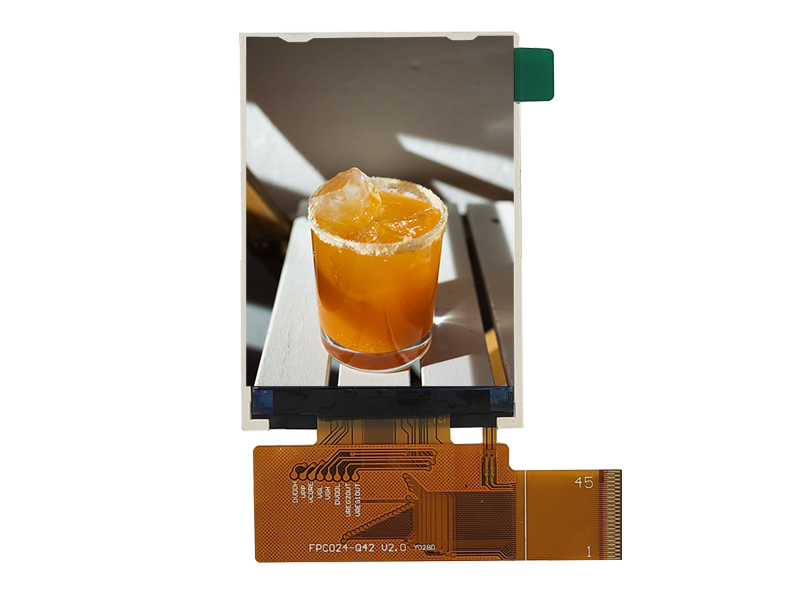
A small-format module. Response figures are only comparable when the measurement method, transition set and temperature travel with the number. Source: CDTech display range.
How does sourcing change with the choice?
Narrower supplier base for the fast variants.
Fast in-plane panels are produced by fewer fabs than standard in-plane panels, which means a smaller approved-panel list, a longer qualification and a higher chance that the exact part is tied to one supplier's roadmap.
The consequence is a supply plan rather than a sourcing preference. Where the fast variant is genuinely needed, the buyer should ask for the panel's expected production window in writing, identify a form-fit-function alternative early, and be prepared to re-qualify the timing controller if the alternative uses a different drive. Where the fast variant is not needed, moving back to a standard panel widens the supplier base and usually shortens the lead time. Panel supply and product-life movements across the industry are tracked by research houses such as TrendForce, and the availability terms belong in the same document as the technical requirement.
Common misreadings in datasheets and quotes
Three readings appear in almost every comparison.
The first is treating a single transition figure as the panel's behaviour, when the specification usually quotes a selected pair. The second is comparing a rise time with an average, which flatters whichever supplier chose the narrower definition. The third is ignoring the temperature at which the figure was taken, which is the reading most likely to matter in an industrial enclosure.
There is also a commercial misreading worth naming: a faster panel is not automatically a better panel for a fixed-content product. The extra drive that shortens transitions can reduce contrast slightly and raise the current, and a control panel that never shows motion will pay both costs without gaining anything. Reading the figure against the content, rather than against the competitor's figure, is the discipline that keeps the specification honest.
What should you verify before design freeze?
Measure the transitions the product will show.
Before freezing, measure the transitions that appear in the actual interface, at both temperature corners, with the production backlight current and the production front stack fitted.
Three supporting checks belong in the same review. Confirm the timing controller's overdrive settings against the panel, because an overdrive table copied from a similar panel can create overshoot artefacts that look worse than the smearing it removed. Confirm the touch or bonded front does not change the apparent behaviour, since an extra optical layer reduces contrast and can make trails more visible. Confirm the assembly and handling practices that protect the panel during build, which for a bonded module follow the workmanship expectations published by IPC and the static control programme of the EOS/ESD Association. The safety context for the finished equipment is set by IEC 62368-1.
Long-term availability for a fast panel
Narrow supply makes the lifecycle plan more important.
Because fewer fabs produce the fast variants, the lifecycle risk for a fast in-plane panel is higher than for a mainstream standard panel, and the mitigation has to be agreed before the design freezes rather than after a notice arrives.
A workable plan names the panel, the timing controller and the bonded front separately and states for each what the supplier will provide: an end-of-life notice period in writing, a last-time-buy quantity tied to the forecast, and a documented alternative that has been evaluated rather than merely listed. Where the alternative is a standard in-plane panel of the same size, the qualification usually reduces to a response and overdrive re-check, which is a much smaller exercise than re-qualifying a bonded stack. A second-source qualification carried out while the first panel is in healthy supply is the control that keeps a long-life product buildable.
FAQ
Is fast IPS better than standard IPS?
It is faster in transition, and it costs a little more power and sometimes a little contrast. For a fixed-content control panel the speed buys nothing; for an interface with scrolling, cursors or moving waveforms it removes the artefacts the user actually notices.
Does a faster response time mean less motion blur?
It reduces the part of motion blur caused by the liquid crystal transition, which is the part the panel controls. The rest comes from how the eye tracks a moving object and from the source frame rate, neither of which changes when the panel gets faster.
Why do two panels quoted at 1 ms behave differently?
Because the figure depends on which transitions were measured, whether it refers to rise, fall or an average, and the temperature at the measurement. Two quotations can be internally honest and still describe different quantities.
Can a fast IPS panel run at a low temperature?
It can, but transitions lengthen as the liquid crystal becomes more viscous, so the low-temperature corner has to be specified and measured. Where the product operates below freezing, plan for a heater, a higher drive voltage or a wider acceptance level.
Next step
Send the interface content, the operating temperature range and the transitions the user will see to CDTech; the reply will state which in-plane variant meets the requirement and what the response acceptance level should read.