Custom LCD Versus Standard Panel: When Custom Is Worth It
Views: 338Author: Site EditorPublish Time: 2026-09-16Origin: Site
Most display programmes start with the same question: can we use a standard module, or do we need a custom one? The honest answer is that customisation is rarely all-or-nothing. It comes in levels, and each level has a different cost, schedule and supply consequence.
This article lays out those levels and gives you a way to compare a standard part and a custom build on the same basis.
What customisation actually changes
It helps to separate three levels. Panel-level changes alter what the display itself is: a non-standard size, a different resolution, a specific glass or coating. Module-level changes keep the panel and alter what surrounds it: backlight construction, touch sensor, bonding, FPC routing, connector choice. System-level changes adapt the module to your product: a different mechanical frame, an integrated controller, firmware or a specific cable exit.
Panel-level changes are the slowest and most expensive because they touch tooling and minimum order quantities. Module-level changes are the most common kind of customisation in practice and often carry no tooling at all. System-level changes are usually your own engineering work rather than the supplier's.
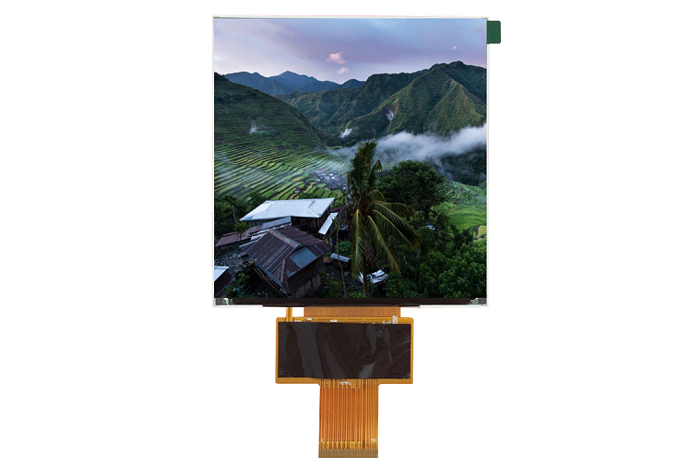
A square 5-inch module: a format that exists precisely because enough programmes needed something a standard 16:9 panel could not provide.
Cost and schedule by customisation level
Customisation cost is driven by three things: tooling, minimum order quantity and engineering time. Module-level changes typically add engineering time and sample cycles but little tooling. Panel-level changes add tooling and raise the minimum quantity, which is what turns a reasonable unit price into a serious commitment.
Schedule follows the same pattern. A standard module with a modified cable assembly can ship in weeks. A custom module with a new touch stack needs sample iterations. A custom panel with new tooling is a months-long programme before the first production unit.
Supply and lifecycle risk compared
The risk profile also depends on who owns the drawing. When you own the assembly drawing, the specification and the test method, a different supplier can in principle build the same part — which makes the custom design less of a lock-in than it first appears. When the supplier owns all three, the design is effectively proprietary and the continuity plan has to be built around them rather than around the drawing.
The risk profile also depends on who owns the drawing. When you own the assembly drawing, the specification and the test method, a different supplier can in principle build the same part — which makes the custom design less of a lock-in than it first appears. When the supplier owns all three, the design is effectively proprietary and the continuity plan has to be built around them rather than around the drawing.
Standard modules have more sources and a longer supply history. Custom builds are usually single-sourced by construction: even when the panel is standard, the assembly drawing, the bonding process and the test fixtures belong to one supplier.
That is not an argument against customising. It is an argument for planning the second source, or at least the exit, at the same time as the customisation. If the product must remain serviceable for a decade, a custom module with no compatible alternative is a long-term liability unless someone else can build to the same drawing.
Standard module with mechanical adaptation: the middle path
The most under-used option is a standard module with an adaptor designed by you. A metal frame, a bezel, a spacer or a cable assembly can absorb many requirements that people assume need a custom display: a different fixing pattern, a different connector position, a specific front appearance.
This path keeps the panel on the open market, keeps tooling either absent or owned by you, and leaves the second-source question answerable. It costs mechanical engineering time, which is usually the cheapest of the three currencies.
Where the middle path fails is when the requirement is optical or electrical rather than mechanical — for example a specific brightness or a non-standard interface that no open-market module provides.
Tooling, MOQ and NRE implications
A worked example makes the levels concrete. A programme needing a standard 7-inch module with a modified cable and a different fixing frame sits at the module level: the commitments are an engineering charge for the cable drawing and a modest increase in unit price, with no tooling and no change to the minimum order quantity. The same programme asking for a 6.8-inch panel with a non-standard resolution moves to the panel level: new tooling, a much higher minimum quantity, and a sample cycle measured in months rather than weeks. The functional difference between the two requests may be a few millimetres of bezel; the commercial difference is an order of magnitude.
Tooling and non-recurring engineering are not the same thing, and quotations often blur them. Ask for them separately: what is paid once, what is paid per unit, who owns the tooling, and what happens to it if the programme ends.
Minimum order quantity is the quieter commitment. A low tooling cost with a high minimum quantity can be worse than the reverse, because the risk moves from a known one-off payment to unsold inventory. For a first product generation, ask what happens if the forecast halves.
Documentation and qualification differences
A standard module arrives with a datasheet written for a family. A custom module arrives with a specification written for your part number, which is better — provided it is maintained. Custom builds need change control that names you, because the supplier's other customers may share the design.
Plan for two additional documents on custom builds: the approved specification with measurement conditions, and the change-notification arrangement. Without them, a silent process change can invalidate your own qualification work.
Comparing a standard and a custom quotation fairly
A fair comparison puts both paths on the same basis.
Cost line
Standard module
Custom module
Unit price
Lower, published
Higher, tied to volume
Tooling / NRE
Usually none
One-off payment; ask who owns the tooling
Your engineering
Higher: adaptor, frame, cabling
Lower: the module arrives closer to final
Qualification
Against a family datasheet
Against your own specification
Supply risk
Multiple sources possible
Usually single source; plan the exit
Minimum quantity
Low
Rises with panel-level customisation
Add the columns up over the product's whole life, not over the first order. That is where the two paths usually separate by a wide margin.
Phasing customisation across product generations
A useful discipline is to separate customisation that affects the user from customisation that only affects your factory. A different interface, brightness or glass treatment is visible to the customer and worth paying for early. A different connector position or cable length matters mainly to assembly, and those changes are often cheaper to absorb with an adaptor in the first generation and to fold into the module later.
A useful discipline is to separate customisation that affects the user from customisation that only affects your factory. A different interface, brightness or glass treatment is visible to the customer and worth paying for early. A different connector position or cable length matters mainly to assembly, and those changes are often cheaper to absorb with an adaptor in the first generation and to fold into the module later.
A practical compromise is to start on the middle path and customise later, once volume justifies it. The first generation uses a standard module with your adaptor; the second generation, built to a larger forecast, moves to a custom module with the improvements the first generation taught you.
This keeps the early risk low and avoids locking a young product into a single-source design before you know how it will sell. It also means the customisation is driven by evidence from real units rather than by assumptions at concept stage.
Making the standard-or-custom call
Revisit the decision when the programme's assumptions change rather than only at concept stage. A forecast that triples, a competitor's product that resets the expected appearance, or a regulatory requirement that changes the documentation burden can each move the answer. Treat the standard-or-custom choice as a decision with a review date rather than a permanent property of the design.
Ask in this order: does a standard module with mechanical adaptation meet the requirement? If yes, take it. If not, which level of customisation closes the gap — module or panel? Then check whether the volume and lifetime justify a single-source design.
Not always. Module-level changes such as a different backlight or touch stack can be modest. The cost jumps when panel-level changes require new tooling and a higher minimum order quantity.
Can a custom module have a second source?
Only if the drawing, the process specification and the test method are documented well enough for another supplier to build to them. That is worth arranging at the start rather than after a supply problem.
How long does a custom display programme usually take?
It depends on the level. Module-level changes are measured in sample iterations; panel-level changes with new tooling take substantially longer. Ask your supplier for the milestones rather than a single lead-time number.
The decision also has a time dimension: a standard panel chosen today may be discontinued before a custom one would have been, and a custom one ties the programme to a single tool. Writing both positions into the decision record is what makes the choice defensible two years later.