Copyright © 2020-2021 Shenzhen CDTech Electronics LTD. All rights reserved. Site Map Powered by iwonder.cn

display / touch / bonding solutions
display / touch / bonding solutions
A 5 inch module sits at a useful point in the size ladder. Large enough for a 480-row interface, small enough that a brightness upgrade fits inside a handheld, and close enough to a 7 inch on price that the comparison turns on system cost.
This guide works through the numbers behind that decision: backlight power for a 500 to 1000 nit step, pixel density at handheld distance, the interface boundary and thermal headroom in a plastic case.
A smaller area needs less light for the same luminance.
Brightness is flux per unit area, so the same doubling costs roughly half the light, and half the heat, on a 5 inch panel as on a 7 inch.
A backlight is sized by the flux it must push through polarisers, films and liquid crystal. Luminance is flux divided by area, so a 5 inch module at 500 nits carries about 0.4 W of LED power while a 7 inch at the same brightness carries about 0.7 W.
The gap matters at the top of the range. A 1000 nit version needs twice the flux, and the heat lands on the same bezel and housing. At 5 inch the step is absorbed with a denser LED pitch; at 7 inch it often forces a metal chassis or a fan.
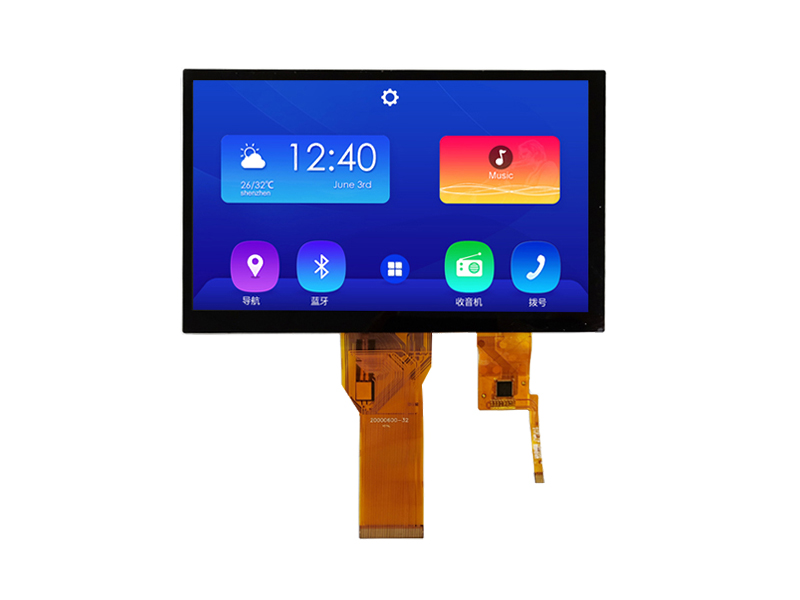
About 0.4 W extra at 5 inch and 0.7 W at 7 inch.
The step follows flux per unit area, so the same 500 nit increase costs roughly twice the LED power, and twice the heat, on the larger panel.
The estimate below treats the backlight as a Lambertian source and folds optical losses into one efficacy term.
P is LED power in watts, L is luminance in cd/m2, A is active area and K is system efficacy in lm/W, near 30 for an edge-lit module. At 500 nits a 5 inch panel of 0.0071 m2 needs 11.2 lm and 0.37 W; at 1000 nits, 22.3 lm and 0.75 W. The 7 inch at 0.0132 m2 moves from 0.69 W to 1.39 W. LED efficacy falls as current rises, so the real step sits slightly above these figures. The optics and backlight guide covers where those losses come from.
About 187 ppi, a 0.136 mm pixel pitch.
At 400 mm the eye resolves roughly 0.12 mm, so the pitch sits just under that limit and text edges read as smooth rather than stepped.
Density follows active area, not resolution alone. A 5.0 inch 800x480 panel measures about 108.9 x 65.3 mm, so each pixel is 0.136 mm wide. One arc minute of acuity equals 0.116 mm at 400 mm, so the panel sits at the limit at arm's length.
That is the right place for a handheld: 14 px text stays crisp and a 480-row layout fits a header, four data rows and a key bar. A 3.5 inch 320x240 panel lands near 114 ppi with a 0.222 mm pitch, comfortable for a keypad and coarse for a table. VESA display standards cover the timing side.
Resolution drives the electronics; area drives everything else. A 5.0 inch and a 7.0 inch module at 800x480 use the same 800 source lines and 480 gate lines, so the driver count barely changes. What changes is glass, light and envelope.
| Cost element | 5.0 inch 800x480 | 7.0 inch 800x480 | System effect |
|---|---|---|---|
| Active area | 71 cm2 | 132 cm2 | Glass and polariser cost |
| Backlight at 500 nits | About 0.37 W | About 0.69 W | Battery life and heat path |
| Source and gate drivers | 800 x 480 | 800 x 480 | Electronics nearly identical |
| Enclosure cut-out | About 109 x 65 mm | About 154 x 86 mm | Wall thickness and stiffness |
A 7 inch at the same resolution buys viewing area and nothing else in electrical terms, while paying for it in glass, light and enclosure volume. That is why a 5 inch module can undercut a 7 inch on total system cost; the industrial LCD display range sets out where that comparison is worth running.
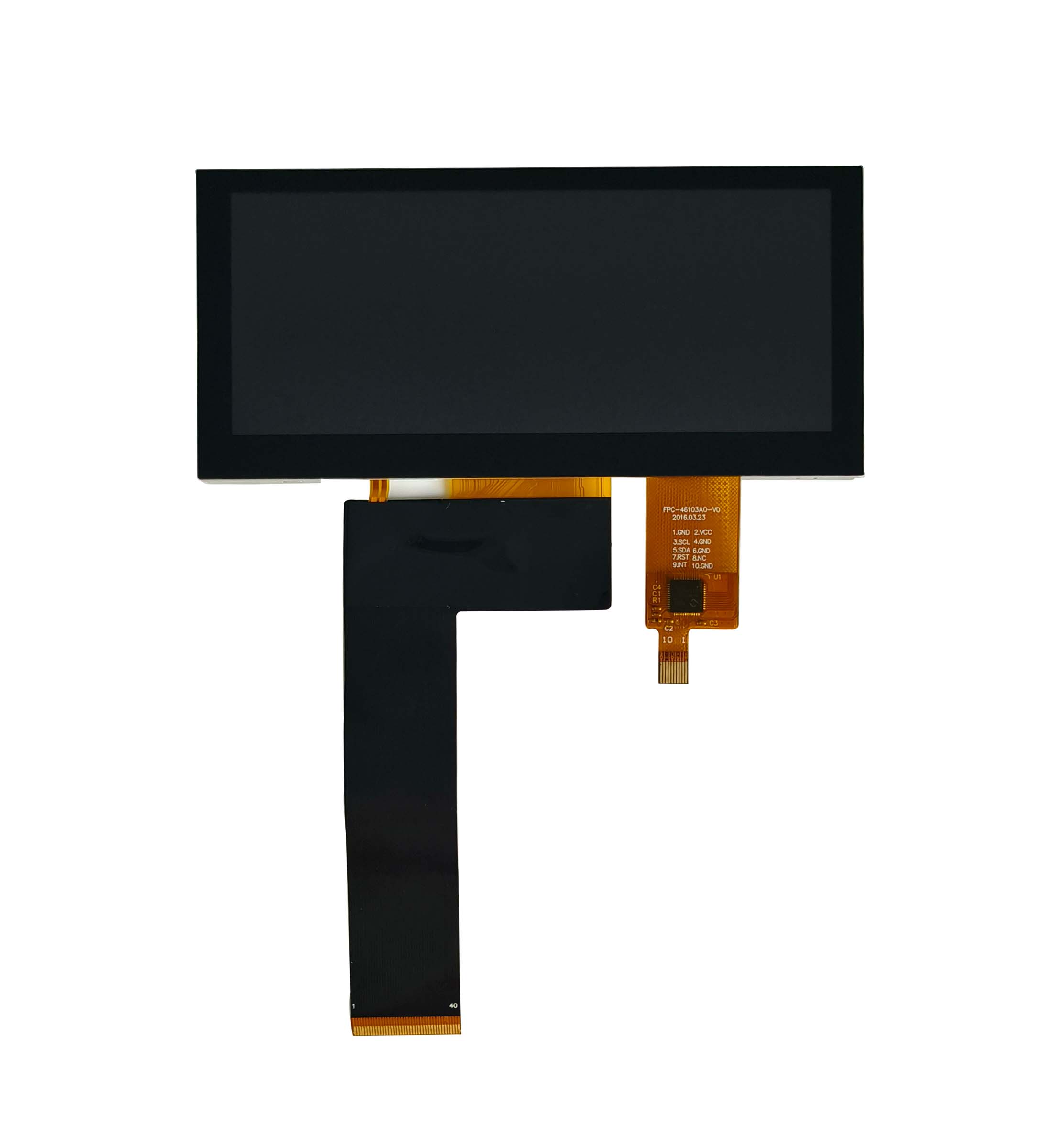
At 800x480 and 60 Hz the pixel clock lands near 33 MHz once blanking is counted, which is where the interface choice stops being arbitrary. Parallel RGB carries 24 data lines plus clock and syncs, close to 28 conductors, while LVDS moves the same payload over four or five differential pairs.
On a 5 inch module the flex is short and sits inside a shielded enclosure, so parallel RGB wins on simplicity: no serialiser, no receiver, no pair skew to control, and a controller that costs less than an LVDS part.
The balance shifts with cable length and emissions. Once the panel sits far from the host board, or the product must meet a tight radiated limit with an unshielded tail, the differential link becomes the cheaper total solution. MIPI DSI is the third option here, specified by the MIPI Alliance.
Roughly 5 to 8 K of rise at 0.75 W in a sealed case.
Natural convection and radiation from a small sealed plastic box give a few kelvin per watt, so a brightness step arrives as a rise across the panel and its LEDs.
A 5 inch module at 1000 nits dissipates about 0.75 W in the backlight, and a sealed ABS housing of handheld size typically sheds that at 6 to 10 K/W, so the inside of the case settles several degrees above ambient.
Three measures recover headroom without changing the panel. A graphite or aluminium spreader behind the light guide moves heat to the case walls; a thermal pad to a metal chassis creates a deliberate path; and a wider LED pitch trades a little cost for a cooler junction. A sealed enclosure cannot rely on vents, and IEC 60529 is the reference for the sealing level the design must hold.
LED drive roughly doubles and the thermal path must follow.
The panel, timing and interface stay put, but the backlight bill of materials, driver headroom and heat spreader all change, and each carries a cost.
There are two ways to double the flux. Adding LEDs along the edge raises cost and light-guide complexity but keeps current per LED low, where efficacy is best. Driving the existing string harder is cheaper on parts and worse on efficiency, because efficacy falls as current rises, and the heat sits in a narrow strip behind the light guide.
Contrast is the second casualty. A brighter backlight leaks more around the bezel and through the black state, so a design that looked deep black at 500 nits can show grey corners unless the light guide, reflector and bezel adhesive are revisited together. LED reliability evidence should be read against the current actually used; for automotive products it is usually read against AEC-Q100 qualification.
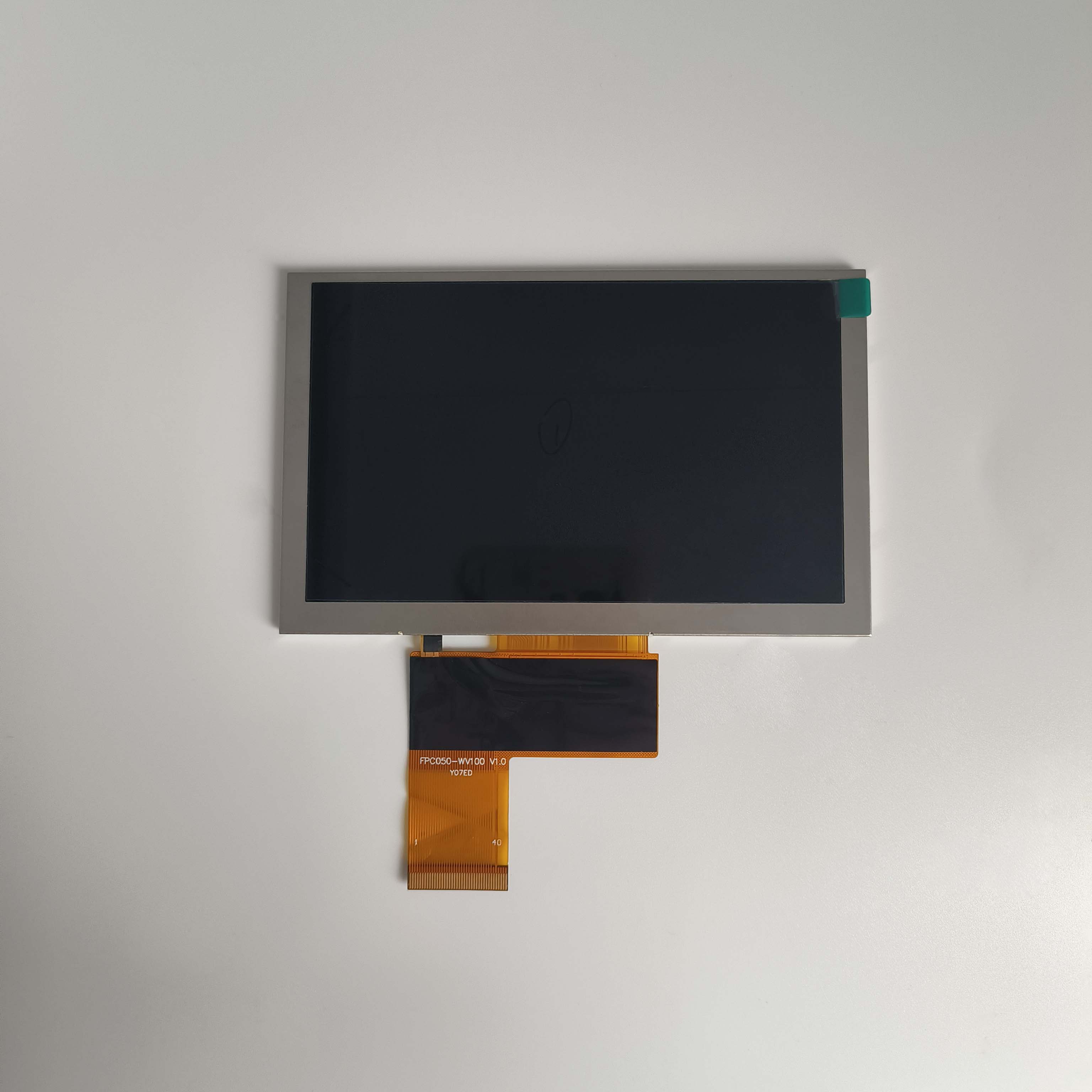
Thickness decides which touch construction survives in a handheld. A 5 inch module might have 1.6 mm of budget for everything in front of the glass, and that has to cover cover glass, adhesive, sensor and any air gap, with tolerance left for the bezel bond.
The layers add up quickly. A 0.7 mm chemically strengthened cover glass, 0.05 mm of optically clear adhesive and a 0.5 mm film sensor land near 1.25 mm, which leaves little room for error. A glass-on-glass sensor is more robust and thicker, while a resistive overlay avoids the lamination but needs an air gap that costs clarity and adds a reflection.
Bonding method matters as much as the layer list. Full OCA lamination removes the internal reflection an air gap creates and improves sunlight readability, at the cost of a rework path when a unit fails. Frame adhesive leaves a serviceable gap and a softer image.
When the enclosure and power budget are already fixed.
A 7 inch at the same 800x480 resolution adds area and consumption without adding information, so it buys legibility at distance and costs battery and mechanical rework.
The clearest case against stretching is a resolution that does not change. Moving from 5.0 to 7.0 inch at 800x480 keeps the same grid, so every element grows larger; if the interface already fits, the extra area buys only a longer viewing distance.
Mechanical factors finish the argument. A 7 inch module adds about 45 mm to the diagonal, which usually means a new front housing, a new overlay die and a heavier product in the hand. Custom variants of the 5 inch format sit under custom LCD display work, and ISO 9001 registration is the baseline most quality teams ask about at the same review.
Comparing a 5 inch module against a 7 inch for a specific enclosure is a calculation, and the inputs are active area, target luminance, ambient temperature and interface length. CDTech can work through those figures for a candidate part and say where the thermal or power budget runs out. Write to [email protected] or use the contact page to start that review.
Is 800x480 enough for a 5 inch panel?
For most handheld instruments it is. At roughly 187 ppi the pixel pitch is 0.136 mm, which sits at or just under the resolution limit of the eye at 400 mm, so text and icons look clean at arm's length. The limit shows up in dense data tables, small chart labels and anything read closer than about 300 mm. If the interface needs more than about five columns of numbers, a 5 inch 720x1280 or a larger diagonal is the more sensible route than shrinking type.
How bright can a 5 inch module go?
Brightness is limited by heat and power rather than by the liquid crystal. A 5 inch module at 1000 nits dissipates roughly 0.75 W in the backlight, which a sealed plastic case can usually absorb with a spreader, and higher targets become a thermal design problem before they become an optical one. Sunlight-readable products in the 1000 nit class are common; beyond that the LED count, the light guide and the enclosure material all change, and the supplier should be asked for measured luminance rather than a target figure.
Which interface is standard at 5 inch?
Parallel RGB is the most common at 800x480 because the pixel clock sits near 33 MHz and the flex run inside a handheld is short. It needs about 28 conductors, which fits a modest connector and a two-layer board. LVDS appears when the panel sits further from the host or when emissions limits are tight, and MIPI DSI is increasingly used where the host processor already provides a DSI port. None of the three changes the image; they change the wiring, the connector and the controller cost.
Does a 5 inch panel need a heatsink at 1000 nits?
Not necessarily, but it needs a deliberate thermal path. At about 0.75 W the backlight raises the inside of a sealed case by several kelvin, and the LED junction runs hotter than the case. A graphite spreader or a thermal pad to a metal chassis is usually enough for a handheld, while an all-plastic housing with no internal metal may need lower drive current or a wider LED pitch. The decision should come from a temperature measurement on a prototype, not from the datasheet alone.
By continuing to use the site you agree to our privacy policy Terms and Conditions.