Copyright © 2020-2021 Shenzhen CDTech Electronics LTD. All rights reserved. Site Map Powered by iwonder.cn

display / touch / bonding solutions
display / touch / bonding solutions
Somebody in a programme meeting proposes a 12.3 inch 1920x720 panel because it looks right in the enclosure. What follows is usually a discovery that the interface is not the one the host board was designed around, that the panel is 3.5 mm thicker than the space allowed, and that the supply commitment was written for a vehicle programme with a different end date.
The format is worth understanding on its own terms rather than treating it as a wide 16:9 panel. Three things make it different: the pixel clock forces a dual-channel interface, the 8:3 canvas breaks assumptions in UI layout, and the parts are automotive in origin, which shapes availability as much as specification.
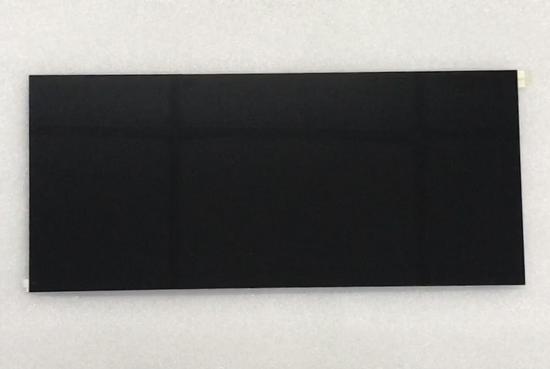
The answer is bandwidth arithmetic, and it explains most of the integration constraints that follow. Run the numbers before you accept a panel's interface description, because two parts with the same resolution can carry different channel counts and therefore different host requirements.
Start from the visible pixels and add blanking. With an illustrative 120 pixel horizontal blanking and 30 line vertical blanking, the totals become 2040 by 750, or 1,530,000 pixels per frame. At 60 Hz that is roughly 91.8 MHz of pixel clock. A single LVDS channel carries seven bits per pixel clock across each pair and is commonly limited to around 85 MHz pixel clock in available transmitters, so this timing sits just past the comfortable single-channel ceiling.
Dual-port LVDS solves it by splitting the frame into left and right halves, each sent on its own channel. Each channel then clocks at roughly half the rate, which brings the design back inside comfortable limits and also halves the data rate on any single pair. The cost is a second connector or a wider FPC, more host pins, and a timing relationship between the two halves that has to be right.
The practical instruction is simple: ask for the interface description in writing, including channel count and FPC pin count, before the board layout starts. On the parts compared here the dual-port variant uses a 50 pin FPC, which is a layout constraint in its own right.
1920 by 720 is 8:3, or 2.67 to 1. That is not a letterboxed 16:9; it is a genuinely different canvas, and interfaces designed for 16:9 look wrong on it in ways that are hard to name until you see them rendered.
Three layout habits survive the transition. Persistent chrome belongs on the long edges rather than the short ones, because the height is the scarce dimension. Horizontal scrolling is worth avoiding altogether, since a wide canvas invites sideways composition that users then have to chase. And typography should be sized against the height, not the width, because a caption that reads well on a 1080p panel will be proportionally smaller here.
The failure mode is stacking: designers take a 16:9 layout and add a right-hand panel to fill the extra width, producing a dashboard that reads as a table rather than an instrument. Resetting the information hierarchy for a wide strip, where the eye sweeps left to right, produces better results than extending a square layout.
Dual-port LVDS is not two independent pictures that happen to sit side by side; it is one frame delivered in two halves, and the halves must arrive in step. When they do not, the symptom is a vertical seam that is sometimes visible only on moving content.
The two reference designs in this size class differ in more than brightness, and comparing them makes the trade-offs concrete.
| Attribute | S123BWU09NP | S123HWU08EP |
|---|---|---|
| Size and resolution | 12.3 inch, 1920x720 | 12.3 inch, 1920x720 |
| Interface | LVDS | 2 port LVDS, 50 pin FPC |
| Luminance | 400 nits | 1000 nits |
| Contrast ratio | 1200 | Not stated on the datasheet summary |
| Display mode / viewing | Normally black, IPS | Normally black, IPS |
| Pixel pitch | 0.1521 x 0.1521 mm | 0.1521 x 0.1521 mm |
| Active area | 292.03 x 109.51 mm | 292.03 x 109.51 mm |
| Module outline | 299.43 x 119.96 x 2.90 mm | 302.10 x 125.50 x 6.35 mm |
| Operating temperature | -20 to +70 C | -30 to +85 C |
| Storage temperature | -30 to +80 C | -40 to +90 C |
The identical active area is the important line. Because both parts share 292.03 by 109.51 mm, a design can move between them without changing the bezel opening, even though the module outline and depth differ substantially. That is the difference between a mechanical change and a mechanical redesign.
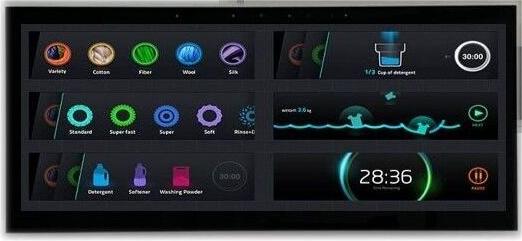
A kiosk programme that selects an automotive-origin panel inherits two things it did not ask for: automotive qualification evidence, which is useful, and automotive lifecycle timing, which is not.
The qualification evidence is a genuine benefit. Parts developed for vehicle programmes are tested against vibration, thermal cycling and shock regimes that a kiosk may never experience, so the reliability margin is usually wider than the application needs. That margin costs money and it is already in the price.
The lifecycle is the problem. An automotive panel follows the vehicle programme, and when that programme ends the panel can go end of life on a schedule that has nothing to do with a kiosk installed base that expects ten years. The mitigation is contractual rather than technical: a written last-time-buy arrangement, an agreed notification period, or a qualified second part before the first one retires. The bar and stretched display guide covers how that planning works for long-life programmes.
There is also a regulatory dimension if the kiosk or signage product ships into the EU. Electronic displays sold there can fall within the scope of the ecodesign requirements for electronic displays, and the exemption boundaries are not obvious from the product description alone. Confirm the scope against the product's own power and function, not against its size.
Many 12.3 inch installations place the panel behind a curved cover glass, and the touch layer has to follow that curve without losing linearity at the edges. Work through the following before committing to a bonded assembly.
Three of these are mechanical and two are electrical, which is why the touch decision cannot be made by the electronics team alone. If the assembly is for an outdoor cabinet, the ingress rating of the finished front face is set by the IEC 60529 classification you claim, not by the panel's own construction.
Not automatically, and over-specifying is a real cost.
The question to ask is which environmental stresses the installation actually produces, then buy qualification against those rather than against a vehicle specification.
Two attributes usually earn their place outside automotive. The first is the wide temperature range: a kiosk in an unheated lobby, a ticket machine on a platform, or a signage strip behind glass all see temperatures outside a comfortable consumer band, and the dual-port part above extends operating range to -30 to +85 C against -20 to +70 C for the standard part. The second is brightness, because 1000 nits is what makes a wide strip legible against daylight, and that requirement is independent of the industry.
What usually does not earn its place is full automotive qualification per AEC-Q100 and related documents. If the product is not a vehicle component, the qualification cost buys margin the application cannot use. Where the automotive part happens to be the only available option at the right geometry, that is a sourcing fact rather than a specification requirement, and it is worth saying so in the design record.
The timing diagram for a dual-port panel carries more constraints than a single-port one, and the constraints that matter are the ones that are easy to skip. Before the board is laid out, extract four things from the datasheet.
First, which port carries which half of the frame, and whether the split is at the midpoint or at a stated pixel boundary. Second, the relationship between the two clock signals: shared clock with a common lane, or two clocks that must be matched within a tolerance. Third, the setup and hold requirements at the connector, which decide how much length matching the FPC and the board traces need. Fourth, the power sequencing order, because some dual-port panels require the ports to be enabled in a defined sequence and will show a black half-screen if they are not.
None of these are unusual engineering problems. They are simply problems that cost a board respin if they are discovered after layout rather than before it.
The terms overlap and the products do not. A bar-type display is defined by its extreme aspect ratio and is typically used as a strip for shelf edges, transit signage or appliance fronts, often at small sizes and modest resolutions. A 12.3 inch 1920x720 module is a high-resolution wide canvas designed originally for a dashboard.
The distinction matters for supply and for support. Bar displays are frequently built on mother-glass that has been cut to a non-standard format, which brings its own yield and tooling economics. A native 1920x720 panel is a standard format produced for a large market, so the parts situation is more stable but the format options are narrower.
If the requirement is genuinely a strip, start from the bar-type range and treat the 12.3 inch format as the fallback. If the requirement is a wide information surface at high resolution, start from 1920x720 and treat a bar panel as the compromise.
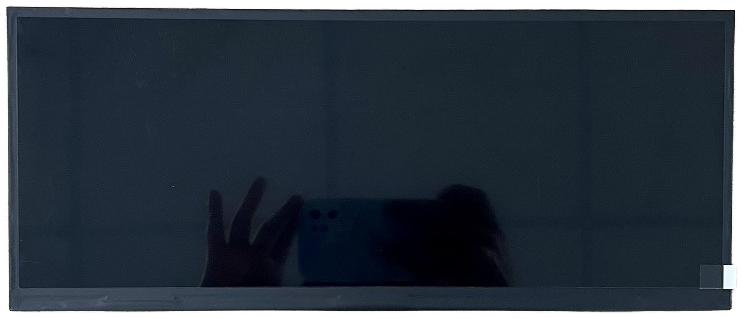
The second LVDS channel is not free, and the cost is easiest to see at the connector. A 50 pin FPC for a dual-port panel consumes board edge that a single-port design may not have budgeted, and it forces the layout to route a second differential group with its own length matching.
Three costs are worth quantifying during the concept phase. The connector cost, which is both a part cost and an assembly cost. The routing cost, which appears as additional board layers if the existing stack cannot absorb two matched differential groups. And the bring-up cost, which is the engineering time to get both halves aligned, and which is the item most often underestimated.
The alternative is a bridge or a controller board that accepts a single input and drives the panel directly. That moves the problem off the host board and into a purchased assembly, which is a reasonable trade on low volumes and a poor one at scale. Either way, decide before the host architecture is frozen.
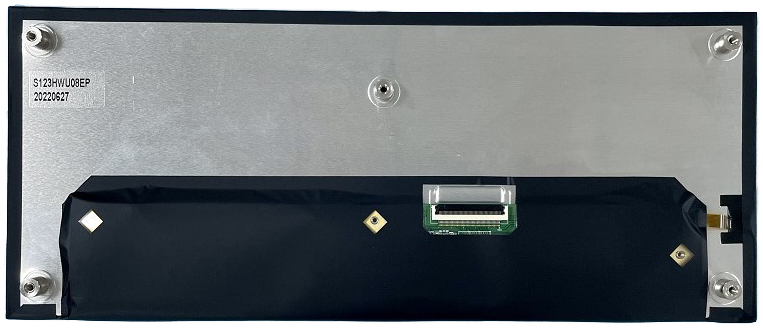
Three decisions carry most of the outcome. Choose the interface before the layout, because retrofitting a second channel is a respin. Choose the brightness variant before the enclosure, because the depth difference between a 400 nit and a 1000 nit build is 3.45 mm and that is enough to break a bezel design. And choose the supply arrangement before the launch, because an automotive-origin panel follows a different clock.
Where the geometry fits, this format is unusually efficient: it uses an enclosure's width without the vertical space a 16:9 panel demands, and it delivers high pixel density across that strip. Where the geometry does not fit, no amount of specification will rescue it, and a vehicle display or standard industrial panel at a more conventional ratio will integrate faster.
Standards work in the background here. Display timing and interface conventions are published by bodies such as VESA, and the mobile-orientated alternative to LVDS is specified by the MIPI Alliance DSI specification. Neither dictates what a 1920x720 panel must do, but both explain why the interface options are the ones you are offered.
Next step. If you are evaluating a 12.3 inch 1920x720 design, send the enclosure drawing, the host interface and the target brightness. CDTech can confirm which of the two builds fits the space and what the interface change costs in practice.
Why does a 1920x720 display need two LVDS ports?
Because the pixel clock needed for 60 Hz at this resolution sits just beyond what a single LVDS channel comfortably carries. With typical blanking, the clock lands around 90 MHz, and common single-channel transmitters top out near 85 MHz. Dual-port LVDS splits the frame into two halves, each on its own channel, which halves the clock each channel must handle.
Is 1920x720 only used in cars?
No. The format started in instrument clusters and centre consoles because it matches the wide band above a dashboard, but the same geometry has moved into kiosks, ticketing machines and signage where a wide strip fits an enclosure better than a 16:9 rectangle. The panel is automotive in origin, not exclusively automotive in use.
Does a kiosk programme need an automotive-grade 1920x720 panel?
Usually not the full automotive qualification. A kiosk needs the wide temperature range and the vibration tolerance only if it is installed somewhere that actually experiences them. What it does need is a supply commitment matched to a longer product life, because an automotive panel can reach end of life on the vehicle programme's schedule rather than the kiosk's.
What is the active area of a 12.3 inch 1920x720 panel?
On the parts in this range the active area measures 292.03 by 109.51 millimetres, with a pixel pitch of 0.1521 by 0.1521 millimetres. The active area is identical across brightness variants, which is what allows a design to move between a standard and a high-brightness part without changing the bezel opening.
How much thicker is a 1000 nit 12.3 inch module than a 400 nit one?
On the parts compared here the module depth grows from 2.90 millimetres to 6.35 millimetres, because a brighter backlight needs more optical distance, more diffuser layers and more thermal mass behind the cell. The active area stays at 292.03 by 109.51 millimetres, so the bezel opening is unchanged and only the rear clearance fails. That is why a brightness upgrade is usually a housing change rather than an electrical one, and why the depth figure should be checked before the enclosure drawing is released.
By continuing to use the site you agree to our privacy policy Terms and Conditions.