Stretched bar LCD manufacturing faces five major challenges: panel cutting precision for ultra-wide ratios like 1920×720, edge sealing reliability to prevent delamination, tolerance control amid thermal expansion mismatches, yield optimization in low-volume custom runs, and uniform brightness across elongated panels. CDTech overcomes these with its glass-cutting patent, zero-defect policy, and IATF16949-certified processes in a 3,500㎡ dust-free workshop.
Check: BAR Type LCD Display
How Does Panel Cutting Work in Stretched Bar LCD Production?
Panel cutting transforms standard TFT LCD mother glass into elongated bar shapes—from typical 16:9 ratios to extreme 6:1 aspect ratios like 1920×720. Manufacturers employ laser-scribing and scribe-and-break techniques to minimize microcracks along cut edges. Precision is critical: dimensional accuracy must maintain ±0.1mm tolerances to ensure proper alignment during assembly. Edge chipping represents a primary failure mode, compromised by the stress concentration inherent in ultra-wide geometries.
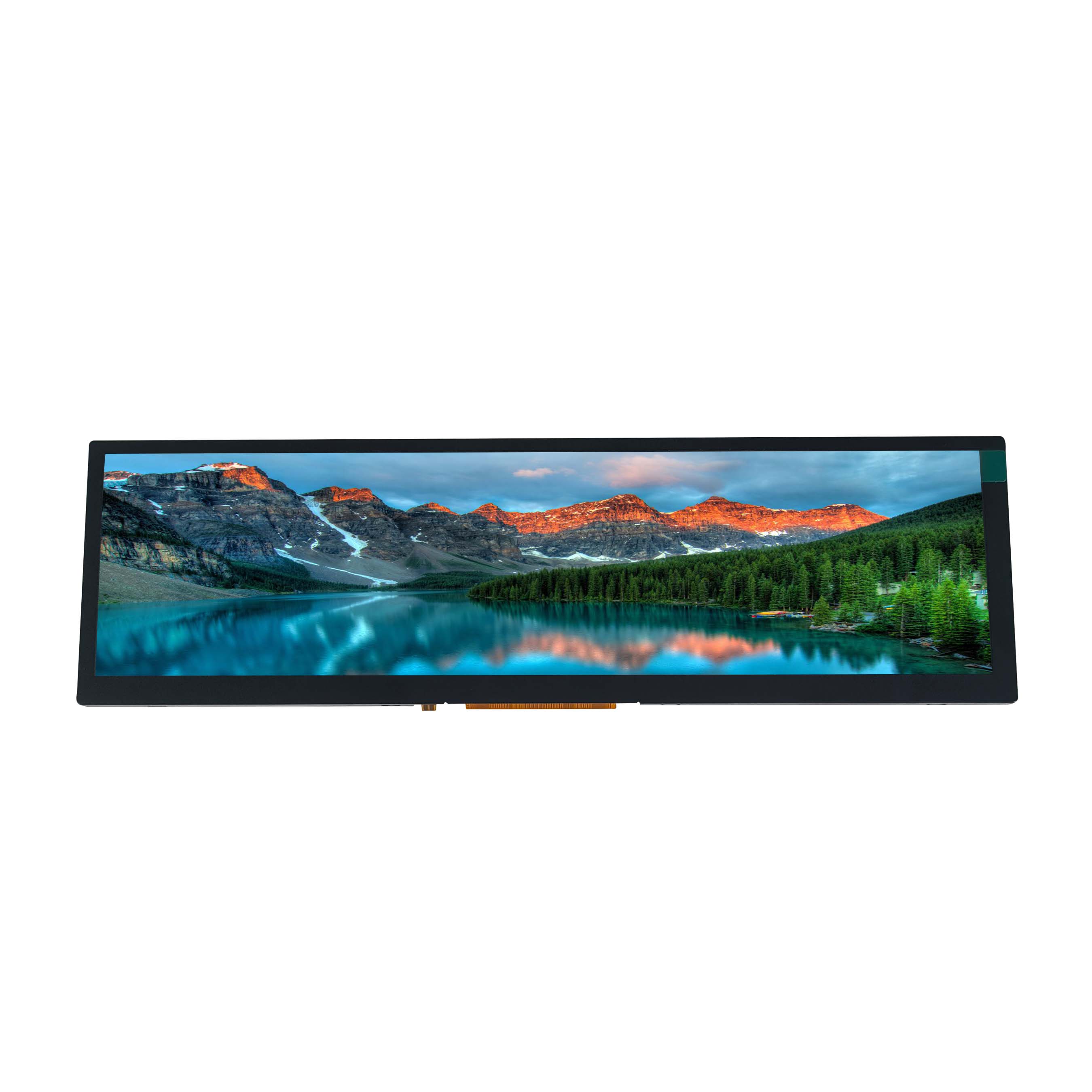
CDTech's proprietary glass-cutting patent (2017) enables precise ultra-wide cuts for models like the S123BWU09NP-FC19 (12.3" bar display at 1920×720). The company's 10,000㎡ factory integrates automated cutting equipment reducing waste in low-MOQ custom runs. In-house automation allows rapid prototyping and iteration, critical for OEMs requiring stretched LCD panels without high minimum orders. This capability distinguishes CDTech among manufacturers handling specialized bar display geometries.
Why Is Sealing Critical for Bar-Type TFT LCD Reliability?
Edge sealing encapsulates liquid crystals and prevents moisture and oxygen ingress, directly impacting display lifespan. Manufacturers apply UV-curable resin or frit glass along cut edges, creating a hermetic barrier. For stretched panels, this process faces elevated risk: the elongated geometry concentrates mechanical stress at edges, increasing delamination probability under thermal cycling between −30°C and +85°C—typical automotive operating ranges.
Failure modes include micro-delamination, where the seal gradually separates from the glass substrate, allowing moisture migration into the liquid crystal layer. This degrades display contrast and color fidelity. CDTech's zero-defect sealing process operates within its thousand-level cleanroom environment, integrated with OCA optical bonding for automotive-grade durability. The company's IATF16949 certification validates this sealing reliability across thermal shock and humidity testing protocols.
| Material | Thermal Stability | Edge Protection | Cost | CDTech Application |
|---|
| UV Resin | Moderate (−40°C to 80°C) | Good | Low | Standard industrial bar displays |
| Frit Glass | High (−30°C to 85°C) | Excellent | Medium | Automotive vehicle dashboards |
| OCA Adhesive | Superior (full range) | Superior | High | Custom vehicle dashboards with touch |
What Tolerance Challenges Arise in Ultra-Wide Aspect Ratio LCDs?
Stack-up tolerances compound in elongated panels. Glass thickness variation, misalignment of polarizer and TFT layers, and LVDS interface compatibility must all stay within ±0.05mm across a panel 200+ millimeters long. Thermal expansion mismatch between glass (CTE ~9 ppm/K) and resin (CTE ~50 ppm/K) causes warping during thermal cycling, particularly severe in bar geometries where stress distributes unevenly.
Check: Touch screen LCD display manufacturer
CDTech addresses tolerance control through statistical process control (SPC) and ISO9001-certified manufacturing. The company's quad certifications—ISO9001, ISO14001, ISO13485, and IATF16949—ensure consistent 1280×320 and 1920×720 bar outputs. Custom stretched LCD designs leverage the R&D team's 10+ years of TFT LCD experience to optimize material selection and process parameters, minimizing warping and interface misalignment.
How Can Manufacturers Optimize Yield in Custom Bar Display Production?
Low yield in stretched LCD production stems from edge defects, sealing failures, and CTP assembly misalignment. Automated POL (polarizer optical lamination), LCD assembly, and CTP (capacitive touch panel) lines reduce manual handling risk. CDTech's 2024 upgrade to fully automatic POL/LCD/CTP equipment directly improved defect detection and rejection at earlier stages.
Statistical process control identifies process drift before yield loss occurs. The company's National High-tech Enterprise designation reflects sustained R&D investment in yield optimization. CDTech's 3,500㎡+ thousand-level dust-free workshop supports contamination-free assembly, reducing particle-induced sealing failures. Zero-defect policy accountability across supply chain and in-house assembly ensures consistent high-yield output for custom bar LCD runs, even at low volumes supporting OEM prototyping and production.
Why Do Thermal Stresses Complicate Bar LCD Sealing Processes?
Thermal stress arises from CTE mismatch between glass, resin, and polarizers during −30°C to +85°C automotive thermal shock testing. In stretched panels, stress concentrates at the elongated edges, creating microcracks propagating toward the seal interface. These cracks breach the hermetic seal, allowing moisture and oxygen ingress that degrades liquid crystal performance over weeks to months in field operation.
Acoustic emission testing detects incipient cracking before catastrophic failure. CDTech's IATF16949 validation includes rigorous thermal cycling protocols ensuring vehicle dashboard displays like the S123BWU09NP-FC19 and S123AWU07ES withstand repeated −30°C to +85°C transitions. OCA bonding, an alternative to traditional edge sealing, mechanically couples the touch panel to the display, distributing stress more uniformly and improving resistance to thermal shock. This advanced approach supports premium automotive applications requiring maximum reliability.
What Role Does Cleanroom Technology Play in Bar-Type TFT LCD Manufacturing?
Thousand-level (ISO Class 6) cleanrooms maintain particle concentrations below 3,500 particles per cubic foot, critical for sealing process integrity. Particulate contamination—dust, fibers, salt residue—introduces defects at the glass-resin interface, causing micro-delamination. In stretched bar panels, where edge length exceeds 250mm, particle-induced failures multiply proportionally.
CDTech's 3,500㎡+ dust-free workshop enables contamination-free panel cutting, sealing, and touch panel assembly. This investment supports medical-grade reliability (ISO13485 certified) and industrial-grade consistency for global exports to Europe, Americas, Middle East, Russia, Japan, and Taiwan. The cleanroom infrastructure directly underpins CDTech's zero-defect policy, reducing field failures and warranty costs for OEMs specifying custom bar LCD solutions.
How Does CDTech Address Bar Display OEM Specifications?
OEM bar LCD specifications integrate multiple challenges: touch technology (CTP multi-touch or PCAP), LVDS or RGB interfaces, brightness uniformity (1000 nits available on models like S088AWX22EB-DC08), and OCA optical bonding. CDTech's design-for-manufacturability (DFM) process evaluates each specification against production capability, identifying cost and risk trade-offs early.
The company's R&D team leverages 13+ years of TFT LCD experience since 2011 to optimize bar LCD performance. Custom designs support aspect ratios from 3.9" (480×128) to 12.3" (1920×720), with interface options spanning RGB, LVDS, MCU, and MIPI. CDTech's National High-tech Enterprise status reflects innovation capability; Shenzhen location enables fast prototyping and direct OEM engagement. Response time commitment of within 24 hours on inquiries accelerates project timelines for demanding automotive and industrial customers.
| Certification | CDTech Status | Benefit for Bar LCDs |
|---|
| ISO9001 | Certified | Quality management and process control |
| ISO14001 | Certified | Eco-friendly production and waste reduction |
| ISO13485 | Certified | Medical-grade sealing and reliability |
| IATF16949 | Certified | Automotive thermal and mechanical durability |
CDTech Expert Views
"Stretched bar LCD manufacturing demands mastery of both cutting precision and sealing integrity. Our patented glass-cutting process combined with fully automatic POL/LCD/CTP assembly delivers 25% yield improvement for OEMs transitioning from standard rectangles to ultra-wide geometries. The key insight: thermal stress concentrates at elongated edges, so early investment in frit glass sealing and OCA bonding prevents costly field failures. Our quad certifications—ISO9001, ISO13485, ISO14001, and IATF16949—ensure every bar display meets automotive and medical durability standards. With 13+ years manufacturing experience and a 3,500㎡ dust-free workshop, CDTech eliminates the guesswork from custom bar LCD design. We maintain zero-defect policy accountability across every production run."
Conclusion
Mastering stretched bar LCD manufacturing requires precision across five critical dimensions: panel cutting, edge sealing, tolerance control, yield optimization, and thermal stress management. Each challenge interconnects—poor cutting tolerances amplify sealing risk; inadequate sealing exacerbates thermal failure. CDTech's 13+ years of TFT LCD expertise, proprietary glass-cutting patent, zero-defect policy, and quad certifications (ISO9001, ISO14001, ISO13485, IATF16949) address these complexities systematically. The company's 10,000㎡ factory with 3,500㎡+ thousand-level dust-free workshop integrates automated cutting, sealing, and CTP assembly—delivering reliable custom bar LCD solutions for automotive dashboards, industrial HMI panels, and medical devices. By partnering with an OEM manufacturer handling both standard and bar-type displays, customers minimize design risk, accelerate time-to-market, and ensure field reliability across thermal extremes and environmental stresses.
Frequently Asked Questions
What is the typical aspect ratio for stretched bar LCDs?
Ultra-wide ratios like 1920×720 (12.3" bar display) or 1280×320 (8.8" bar display) serve automotive dashboards and industrial HMI panels. CDTech customizes aspect ratios via precise cutting and can accommodate ratios from 2.9" to 12.3" across its bar product line.
How does CDTech ensure zero-defect bar LCD sealing?
CDTech combines patented glass-cutting technology, OCA optical bonding, frit glass sealing, and statistical process control within a thousand-level dust-free workshop. IATF16949 certification validates thermal reliability; ISO13485 ensures medical-grade consistency. Quad certifications underpin zero-defect policy accountability.
What industries use custom bar displays from CDTech?
Automotive (vehicle dashboards, center console strips), industrial control (HMI panels, factory automation), medical devices (portable diagnostics), and smart home applications. IATF16949 certification specifically addresses automotive thermal and mechanical durability requirements.
Can CDTech handle low-MOQ stretched LCD production?
Yes. The 10,000㎡ factory with automated POL/LCD/CTP equipment supports custom runs at low minimum order quantities. Fast prototyping and high yields minimize per-unit costs even for pilot production, backed by 24-hour response time on inquiries.
What makes bar LCD panel cutting more challenging than standard panels?
Elongated geometries concentrate mechanical stress at edges, increasing edge chipping and microcracks. Longer edge lengths multiply particle-induced sealing defects. CDTech's glass-cutting patent and automated cutting process mitigate these risks through precision tolerances and contamination control in the dust-free workshop.
Bar and Stretched Display Selection