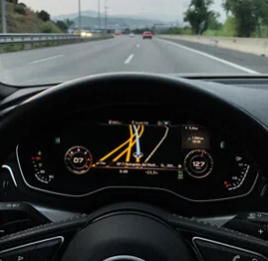
Modern vehicles rely heavily on display technology. From digital instrument
clusters and central infotainment systems to rear-seat entertainment and head-up
display integrations, the car display has become a core interface between the
driver, passengers, and the vehicle’s electronic systems. As automakers move
toward fully digital cockpits, selecting the right display technology is no
longer just a design choice—it directly affects usability, safety, reliability,
and long-term performance.
Among the most commonly discussed technologies for automotive displays are
LCD, TFT (a specific type of LCD), and OLED. While these terms are sometimes
used interchangeably in marketing, they represent different technical approaches
with distinct advantages and limitations in automotive environments.
Understanding these differences is essential for OEMs, Tier 1 suppliers, and
system integrators when specifying displays for production vehicles.
The Role of Display Technology in Modern Automotive Systems
Car displays operate under much harsher conditions than consumer
electronics. They must function reliably in wide temperature ranges, maintain
visibility under direct sunlight, resist vibration and shock, and meet strict
automotive qualification standards. In addition, displays in vehicles are
safety-related components, especially for instrument clusters and advanced
driver assistance system (ADAS) interfaces.
Because of these factors, a display technology that performs well in
smartphones or consumer tablets may not automatically be suitable for long-term
automotive use. The choice between LCD, TFT-LCD, and OLED is therefore not only
about image quality, but also about durability, lifetime, supply chain
stability, and compliance with automotive-grade requirements.
Understanding Standard LCD Technology in Automotive Displays
Liquid Crystal Display (LCD) is a broad category that has been used in
automotive applications for decades. Traditional LCDs rely on a backlight unit,
liquid crystal material, and polarizing filters to modulate light and form
images. In early automotive dashboards, monochrome or segmented LCDs were widely
used for basic information such as speed, fuel level, and warning
indicators.
In today’s vehicles, standard LCD technology is still used in certain
cost-sensitive applications, especially where color depth, fast refresh rates,
or wide viewing angles are not critical. These displays are typically paired
with LED backlights and can be designed to meet automotive temperature and
reliability standards.
However, standard LCDs have inherent limitations in contrast ratio and
viewing angle compared to more advanced display types. Black levels are limited
because the backlight is always on, and sunlight readability often requires
higher backlight power, which can increase energy consumption and thermal
load.
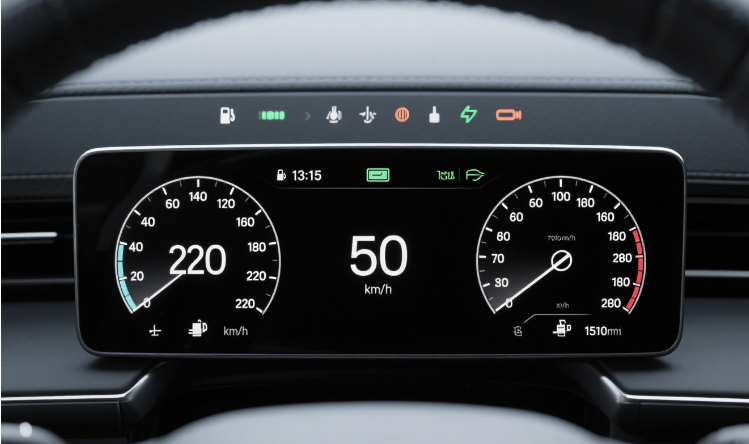
TFT-LCD: The Automotive Industry Standard
TFT (Thin-Film Transistor) is not a completely separate display type, but
rather a more advanced form of LCD technology. In a TFT-LCD, each pixel is
controlled by its own thin-film transistor, enabling faster response times,
better image stability, higher resolution, and improved color performance.
In modern automotive design, TFT-LCD has become the dominant technology
for:
Digital instrument clusters
Center stack infotainment displays
HVAC control panels with graphical interfaces
Rear-seat entertainment screens
TFT-LCD offers a strong balance between performance, reliability, and cost.
Automotive-grade TFT displays can be engineered for wide temperature operation
(often -40°C to +85°C or higher), high brightness for sunlight readability, and
long service life measured in tens of thousands of hours.
Another key advantage is supply chain maturity. TFT-LCD technology is
widely produced by multiple global manufacturers, making it easier for
automotive OEMs to secure long-term availability and avoid obsolescence issues.
This is a critical factor for vehicle platforms that remain in production for
many years.
OLED Car Displays: Premium Image Quality and Design Flexibility
OLED (Organic Light Emitting Diode) displays represent a fundamentally
different approach. Unlike LCD-based technologies, OLED pixels are
self-emissive, meaning each pixel generates its own light. This eliminates the
need for a backlight, enabling extremely high contrast ratios, true blacks, and
very thin display modules.
From a visual perspective, OLED offers clear advantages:
Perfect black levels and very high contrast
Excellent color saturation
Wide viewing angles
Ultra-thin and lightweight form factors
These characteristics make OLED particularly attractive for premium vehicle
interiors, where design differentiation and visual impact are important. OLED
displays are increasingly seen in high-end instrument clusters, curved dashboard
displays, and luxury infotainment systems.
However, OLED technology also introduces challenges in automotive use.
Organic materials are more sensitive to heat and humidity, and long-term image
retention (burn-in) can be a concern for displays that show static content, such
as speedometers or fixed UI elements. Automotive-grade OLED solutions address
many of these issues through advanced materials and software mitigation, but
they typically come at a higher cost.
Performance Comparison in Automotive Conditions
When comparing LCD, TFT-LCD, and OLED for car displays, real-world
automotive performance is more important than laboratory specifications.
In terms of brightness, TFT-LCD generally performs very well, especially
for sunlight-readable applications. High-brightness TFT panels with optimized
backlight systems can exceed 1,000 nits, making them suitable for open-cabin
glare conditions. OLED displays, while excellent in contrast, may require
careful thermal and power management to maintain high brightness over long
periods.
For temperature resistance, TFT-LCD has a long track record in automotive
environments. OLED technology is improving rapidly, but TFT-LCD remains the more
conservative and proven choice for extreme temperature ranges and long-term
durability.
From a lifetime perspective, TFT-LCD typically offers predictable and long
operational lifetimes. OLED lifetime has improved significantly, but depending
on usage patterns and content, degradation characteristics can vary, which may
be a consideration for high-mileage vehicles or commercial fleets.
Cost, Scalability, and Supply Chain Considerations
Cost remains a major factor in automotive display selection. Standard LCD
and TFT-LCD solutions benefit from large-scale manufacturing and mature
production processes, resulting in competitive pricing and stable
availability.
OLED displays are generally more expensive, not only in panel cost but also
in integration, thermal design, and long-term validation. For mass-market
vehicles, this can be a limiting factor. For premium and luxury segments,
however, the higher cost may be justified by the design and visual
advantages.
Scalability is another important issue. TFT-LCD technology supports a wide
range of sizes, resolutions, and aspect ratios, making it suitable for both
small auxiliary displays and large integrated cockpit screens. OLED also
supports flexible and curved designs, but with fewer suppliers and more limited
high-volume automotive-grade options.
Choosing the Right Technology for Different Automotive Applications
There is no single “best” display technology for all automotive use cases.
Instead, the optimal choice depends on the application, target vehicle segment,
cost structure, and design priorities.
For most mainstream instrument clusters and infotainment systems,
automotive-grade TFT-LCD remains the preferred solution due to its balance of
performance, reliability, cost, and long-term availability.
For premium vehicles and design-driven interiors, OLED can provide a strong
differentiation through superior contrast, slim form factors, and advanced
styling options, especially for curved or seamless display surfaces.
Standard LCD technology still has a role in simpler or cost-sensitive
applications, where basic display functionality is sufficient and advanced image
quality is not required.
Future Outlook for Automotive Display Technologies
As digital cockpits become more integrated and software-defined, display
technology will continue to evolve. Micro-LED, advanced mini-LED backlighting
for TFT-LCD, and next-generation OLED materials are all under active
development. These technologies aim to combine high brightness, long lifetime,
and premium image quality in a single solution.
In the near to medium term, TFT-LCD is expected to remain the dominant
automotive display technology, while OLED adoption will continue to grow in
higher-end segments. OEMs and Tier 1 suppliers will increasingly use a
mixed-technology approach, selecting different display types for different zones
within the vehicle.
Conclusion: Balancing Performance, Reliability, and Design
Choosing between LCD, TFT-LCD, and OLED for automotive use is ultimately a
strategic decision. TFT-LCD offers proven reliability, strong performance, and
cost efficiency, making it the industry standard for most vehicle platforms.
OLED delivers superior visual quality and design flexibility, positioning it as
a premium solution for high-end applications. Standard LCD remains relevant for
simpler, cost-driven use cases.
For automotive manufacturers and system integrators, the key is to align
display technology selection with vehicle positioning, environmental
requirements, and long-term production strategy. A well-chosen display solution
not only enhances the driving experience, but also contributes to vehicle
safety, brand perception, and total lifecycle cost.