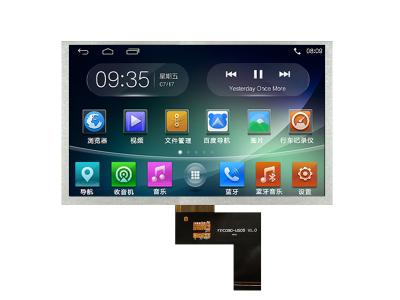
Bar displays, often referred to as stretched displays, have become an
important interface solution across industrial, commercial, and consumer
applications. Their ultra-wide aspect ratios and compact vertical dimensions
make them ideal for applications where information needs to be presented clearly
without occupying excessive space. Among the available technologies, LCD bar
displays and OLED bar displays are the two most commonly considered options.
Although both technologies can meet modern display requirements, they
differ significantly in structure, performance characteristics, reliability, and
cost. Understanding these differences is essential for choosing the right
solution for a specific use scenario.
Basic Differences Between LCD and OLED Bar Displays
LCD bar displays are based on liquid crystal technology combined with an
LED backlight. The backlight provides a uniform light source, while liquid
crystals control how much light passes through each pixel to form an image. This
structure makes LCD technology mature, stable, and suitable for long-term
operation.
OLED bar displays, by contrast, use self-emissive organic light-emitting
diodes. Each pixel generates its own light and can be turned on or off
independently. Because there is no backlight, OLED displays can be much thinner
and achieve higher contrast levels.
This fundamental structural difference explains many of the performance
variations between the two technologies.
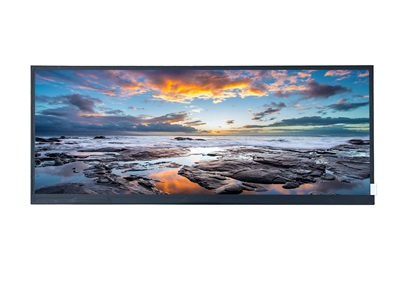
Visual Performance and Image Quality
From a visual perspective, OLED bar displays are often praised for their
excellent contrast and true black levels. Since individual pixels can be
completely switched off, black areas appear deep and clean, which enhances
overall image depth and color richness. This makes OLED especially attractive
for design-focused or premium products.
LCD bar displays, while unable to achieve true blacks due to backlight
leakage, have made significant progress in image quality. Modern IPS LCD bar
displays offer wide viewing angles, stable color reproduction, and consistent
brightness across the panel. For most industrial and commercial applications,
the visual performance of an LCD bar display is more than sufficient.
When it comes to brightness, LCD bar displays usually have a clear
advantage. High-brightness LCD solutions are widely available and perform
reliably in environments with strong ambient light, such as outdoor displays or
factory floors. OLED displays, although capable of high peak brightness, are
generally less suitable for prolonged high-brightness operation.
Power Consumption and Operating Characteristics
LCD bar displays consume power in a relatively predictable manner because
the backlight remains active regardless of displayed content. Power usage mainly
depends on brightness level and panel size. This makes LCD displays easier to
manage in systems designed for continuous operation.
OLED bar displays consume power dynamically. Dark content requires less
energy, while bright or white content significantly increases power consumption.
In applications where static, bright interfaces are displayed for long periods,
OLED panels may consume more power overall and experience faster material
aging.
Lifespan and Long-Term Reliability
Lifespan is a critical factor for many professional applications. LCD bar
displays are well known for their long service life and stable performance, even
in 24/7 operation scenarios. They are also resistant to image retention, making
them suitable for interfaces with fixed layouts or static data.
OLED bar displays, on the other hand, rely on organic materials that
gradually degrade over time. This can lead to reduced brightness and color
shifts, particularly if certain pixels are used more frequently than others.
Image burn-in remains a concern in applications with static UI elements, despite
ongoing improvements in OLED technology.
For systems where reliability and maintenance costs are a priority, LCD bar
displays are often the safer choice.
Environmental Adaptability and Application Stability
In demanding environments, such as industrial control systems,
transportation equipment, or outdoor installations, LCD bar displays demonstrate
strong adaptability. Many models are designed to operate across wide temperature
ranges and maintain performance under vibration, humidity, and continuous
use.
OLED bar displays are more sensitive to environmental conditions,
especially temperature extremes and moisture. As a result, they are typically
better suited to controlled indoor environments rather than harsh industrial
settings.
Design Flexibility and Integration Considerations
OLED bar displays offer clear advantages in terms of physical design. Their
ultra-thin structure and lightweight construction make them ideal for sleek,
modern products where space and aesthetics are critical. OLED technology also
supports curved or flexible designs more easily, enabling innovative product
forms.
LCD bar displays are thicker due to the backlight module, but this also
makes them mechanically robust. For equipment that requires rigid mounting,
protective enclosures, or long-term structural stability, LCD displays integrate
more easily into traditional designs.

Cost and Commercial Viability
Cost is often a decisive factor in display selection. LCD bar displays
benefit from a mature supply chain, large-scale manufacturing, and broad
customization options. This results in lower unit costs, better availability,
and shorter lead times, especially for industrial or B2B projects.
OLED bar displays remain more expensive, particularly for custom sizes and
non-standard aspect ratios. They are usually chosen for high-end products where
visual impact and design differentiation justify the higher cost.
Choosing the Right Display for Different Scenarios
There is no single “best” bar display technology—only the most appropriate
one for a given application.
LCD bar displays are typically the preferred choice for industrial
equipment, transportation systems, medical devices, and public information
displays. Their high brightness, long lifespan, environmental tolerance, and
cost efficiency make them well suited for professional and continuous-use
environments.
OLED bar displays are better suited to consumer electronics, premium retail
displays, and smart devices where thin design, high contrast, and visual appeal
are prioritized, and operating conditions are well controlled.
Conclusion
When comparing LCD bar displays and OLED bar displays, the decision should
be based on practical requirements rather than visual appeal alone. LCD
technology offers reliability, longevity, and strong performance across a wide
range of environments, while OLED technology delivers superior contrast and
design flexibility for high-end applications.
By carefully evaluating operating conditions, usage patterns, lifespan
expectations, and budget constraints, designers and manufacturers can
confidently select the bar display technology that best supports their product
goals and long-term value.