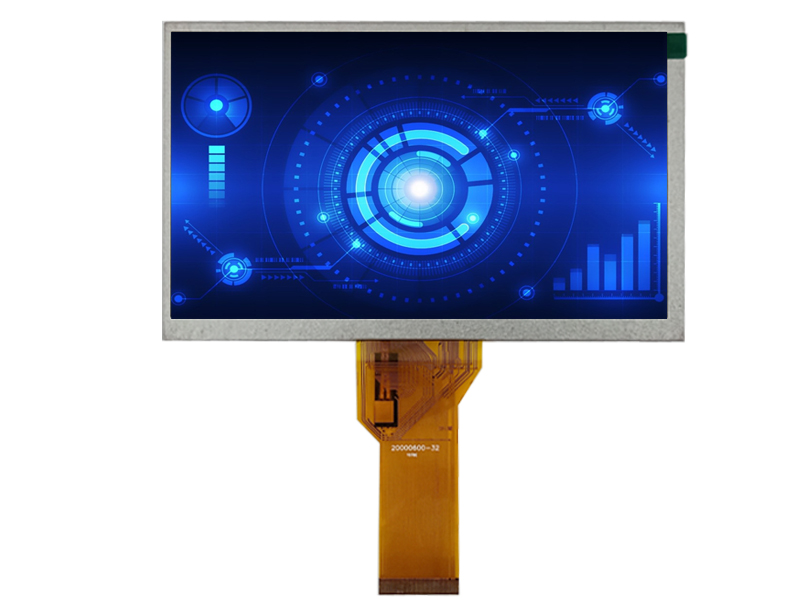
LCD display technology remains a practical and widely used solution for industrial equipment, medical devices, vehicle systems, instrumentation, and other applications that require clear, reliable visual information. While LCDs may appear simple from the outside, the display performance users see is the result of several technologies working together, including the LCD panel, TFT backplane, backlight, display driver, touch interface, and communication interface.
For equipment manufacturers, understanding these technologies is important when selecting an industrial display. The right combination of panel type, resolution, brightness, viewing angle, interface, and environmental performance can have a direct impact on how effectively a display works within the final device.
What Is LCD Display Technology?
LCD stands for Liquid Crystal Display. Unlike emissive display technologies, an LCD does not generate light directly from its liquid crystal layer. Instead, liquid crystals control how light from a backlight passes through the display to form images.
A typical LCD module contains several functional layers and components. The liquid crystal layer controls light transmission, while polarizers and color filters help create the required colors and images. Behind the panel, a backlight provides illumination, and a driver circuit controls the pixels according to the incoming image data.
Modern industrial LCDs commonly use TFT (Thin-Film Transistor) technology. A TFT backplane provides individual control of pixels, allowing the display to produce detailed images with stable and accurate image reproduction.
This combination of LCD and TFT technology has made TFT LCD displays suitable for a wide range of equipment where consistent visual performance and long-term reliability are important.
Key Technologies Used in Industrial LCD Displays
LCD display technology is not limited to the panel itself. Several technologies determine how a display performs in a real industrial environment.
TFT LCD Technology
TFT LCD is one of the most widely used LCD technologies for industrial displays. Each pixel is controlled through thin-film transistors, enabling active-matrix operation and allowing the display to provide higher resolution and better image control than older passive-matrix LCD designs.
TFT LCD modules are available in many sizes and resolutions, making them suitable for compact control panels as well as larger equipment interfaces. They can also be combined with different interfaces, touch technologies, and mechanical configurations depending on the requirements of the application.
IPS and TN Panel Technology
The LCD panel structure also affects viewing performance.
IPS (In-Plane Switching) technology is known for its wide viewing angle and stable image appearance when viewed from different directions. It is often useful when several operators need to view the same screen or when the display cannot always be positioned directly in front of the user.
TN (Twisted Nematic) technology offers a different balance of performance and cost. Depending on the application, TN panels can provide a practical solution where extreme viewing angles are less important.
The choice between IPS, TN, and other LCD technologies should therefore be based on the actual operating requirements rather than simply selecting the most advanced panel type.
LED Backlight Technology
Because LCD panels do not produce their own light, a backlight is essential.
Modern industrial LCD displays commonly use LED backlights because they can provide good brightness, relatively low power consumption, and long operating life. Backlight design also plays an important role in applications exposed to strong ambient lighting.
For outdoor or high-light environments, a higher-brightness LCD may be required to maintain screen readability. In some industrial applications, displays with brightness levels around 1000 nits or higher can be considered depending on the installation environment.
Touch Display Technology
Touch technology can be integrated with an LCD to create a more interactive human-machine interface.
Common solutions include projected capacitive touch technology, which can provide multi-touch operation and a smooth user interface. For industrial equipment, the touch solution also needs to be considered together with factors such as glove operation, surface durability, water resistance, and environmental conditions.
A touch display is therefore more than an LCD panel with a touch layer. The LCD, touch sensor, cover glass, controller, and mechanical structure need to work together as a complete module.
Display Interfaces
The interface determines how the LCD communicates with the main control system.
Depending on the display and application, interfaces may include SPI, MCU, RGB, LVDS, and MIPI, while some industrial display solutions can also incorporate HDMI through an appropriate controller board.
Interface selection should be made according to the host system, required resolution, data rate, cable length, available hardware, and software architecture. Choosing an interface at an early stage can help avoid compatibility issues during product development.

Important LCD Display Parameters for Industrial Applications
Panel technology is only one part of the selection process. Several specifications can influence whether an LCD display performs properly in the final device.
Resolution determines the amount of visual detail that can be displayed. Higher resolution can be useful when an interface contains detailed graphics, measurement data, or multiple information areas.
Brightness affects readability under different lighting conditions. Indoor equipment may require relatively moderate brightness, while outdoor or high-ambient-light equipment may require a much brighter display.
Viewing angle determines how clearly the screen can be viewed away from the center position. This is particularly important for equipment operated by multiple people or devices where the screen cannot be positioned directly in front of the operator.
Contrast ratio affects the distinction between bright and dark areas of an image. A suitable contrast level can improve the overall clarity of graphical interfaces and displayed information.
Operating temperature is another important consideration for industrial equipment. Displays installed in outdoor equipment, vehicles, or machinery may encounter significant temperature variations. Selecting a panel and supporting components suitable for the expected temperature range can improve reliability.
Other factors, including response time, color performance, backlight life, touch performance, power consumption, and mechanical dimensions, should also be considered according to the specific device.
Why Customization Matters in Industrial LCD Displays
Industrial equipment rarely follows a single standard design. The available installation space, control system, user interface, and environmental conditions can vary considerably from one device to another.
For this reason, a standard LCD module may not always provide the best fit. A custom LCD display can be developed around specific requirements such as display size, resolution, brightness, viewing angle, interface, touch function, FPC configuration, and mechanical integration.
Customization can also involve selecting the appropriate panel technology and integrating additional components into a complete display module. This allows equipment manufacturers to focus on the requirements of their own products instead of redesigning the entire system around an off-the-shelf display.
Choosing the Right LCD Display Technology
There is no single LCD display technology that is ideal for every industrial application. The right solution depends on how and where the display will be used.
When selecting an industrial LCD, manufacturers should first define the basic requirements, including:
Required display size and resolution
Indoor or outdoor operating environment
Required brightness and viewing angle
Expected operating temperature range
Touchscreen requirements
Available communication interface
Installation space and mechanical structure
Power and backlight requirements
Expected service conditions and product lifetime
Once these requirements are clear, the appropriate LCD panel technology, backlight, touch solution, interface, and mechanical configuration can be evaluated together.
A display for an industrial control panel, for example, may prioritize viewing angle, touch operation, and interface compatibility. A vehicle display may place greater emphasis on brightness and temperature performance. Medical equipment may require a different combination of image quality, reliability, touch functionality, and integration requirements.
LCD Display Technology for Modern Industrial Equipment
The development of LCD display technology has made it possible to build display modules that are increasingly adaptable to different equipment designs. TFT LCD panels, IPS technology, LED backlights, touchscreens, high-brightness solutions, and multiple interface options give manufacturers considerable flexibility when developing industrial human-machine interfaces.
For companies developing new equipment, the most effective approach is not simply to compare individual LCD specifications. The complete display solution should be evaluated according to the device's operating environment, system architecture, mechanical requirements, and user interface.
With experience in industrial LCD development and manufacturing, CDTech provides TFT LCD and display solutions for applications including industrial control, medical equipment, smart-home devices, automotive and vehicle systems, and instrumentation. Its display portfolio includes different panel sizes, technologies, touch solutions, and interface configurations, with customization available for specific project requirements.
Choosing the right LCD display technology at the beginning of a product development project can help ensure better compatibility between the display and the overall system, while providing the visual performance and reliability required by the finished equipment.